Garage door replacement
Should You Repair or Replace Your Garage Door?
A noisy roller or failed spring usually does not justify replacing an entire garage door. Structural damage, unavailable sections, repeated failures and changing property needs can alter the calculation. This guide helps Wichita homeowners and businesses compare a focused repair with section, door or complete system replacement.
Repair is usually sensible when damage is localized, compatible parts remain available and the door, tracks and supporting structure are sound. Replacement becomes more practical when sections are structurally compromised, damage is widespread, matching parts are obsolete, repeated repairs affect several systems or the existing door no longer meets insulation, clearance, security or operational needs.
A noisy roller or failed spring usually does not justify replacing an entire garage door. Structural damage, unavailable sections, repeated failures and changing property needs can alter the calculation. This guide helps Wichita homeowners and businesses compare a focused repair with section, door or complete system replacement. Continue with the complete library of garage door replacement guides when you want to compare related decisions.
Key takeaways
- A failed spring, roller or opener component does not automatically require a new door.
- Deeply creased sections, damaged attachment points and distorted openings can make replacement safer and more coherent.
- A new door changes weight, spring sizing, track and opener compatibility; the whole system must be reviewed.
- Cosmetic, functional and safety concerns should be separated before comparing options.
- The best value is the option that restores dependable operation without preserving hidden system-wide problems.
Start by defining what failed
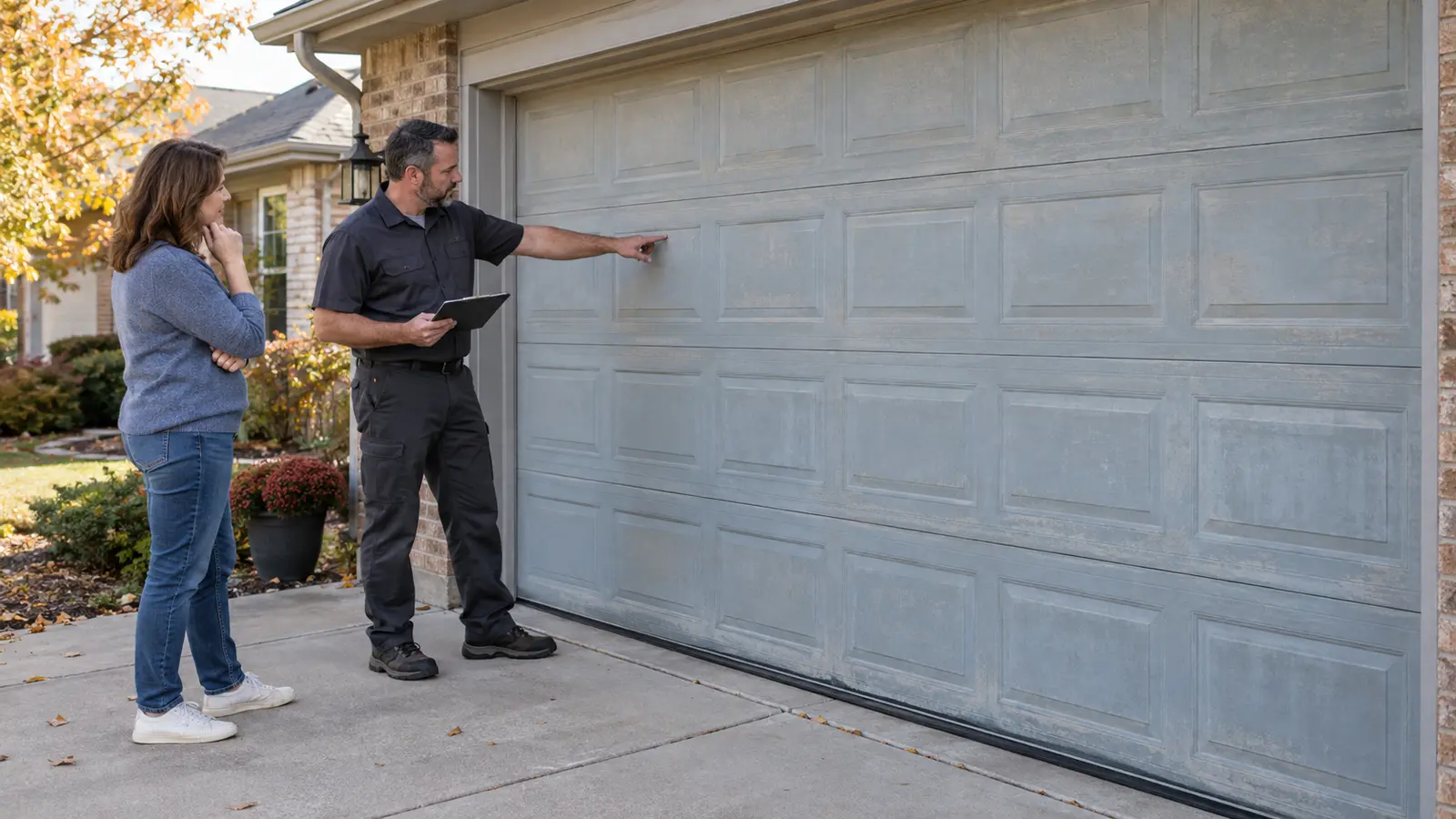
The phrase 'garage door problem' can describe a broken spring, damaged cable, bent track, failed roller, cracked hinge, noisy opener, misaligned sensor, dented panel, rotted wood section or distorted opening. These conditions do not have the same scope. Before comparing repair and replacement, identify whether the failure is a component, one section, the full door, the automatic operator or the structure supporting the system. If this condition matches your situation, review the service scope for garage door repair.
Separate the visible symptom from the cause. A door may scrape because a track moved after impact, not because the panel itself needs replacement. An opener may reverse because the door is heavy from a spring failure, not because the motor is defective.
A bottom section may deteriorate from recurring water exposure, suggesting drainage and sealing concerns beyond the section. Replacing the wrong layer leaves the real problem in service.
Note when the change occurred and what happened immediately before it. Vehicle impact, high wind, a loud bang, remodeling, new weather seals or gradual noise each point the inspection in a different direction.
Stop operation when the door is crooked, dropping, off track or has loose cables or broken spring components. The first decision is safety and stabilization; repair-versus-replace comes after the system can be evaluated.
Component
Springs, cables, rollers, hinges, sensors and operator parts can often be serviced individually.
Door
Sections, stiles, end caps, bottom fixtures and track geometry determine structural condition.
Opening
Framing, backing, floor, clearances and weather exposure influence both repair and replacement.
When a focused repair usually makes sense
Repair is generally attractive when one identifiable component has failed and the surrounding system remains compatible and serviceable. Examples include replacing a properly diagnosed spring, cable, roller, hinge, sensor or opener component; correcting track alignment after a minor disturbance; or adjusting travel after mechanical conditions are restored. The work should include verification that the failure did not damage related parts. If this condition matches your situation, review the service scope for garage door replacement.
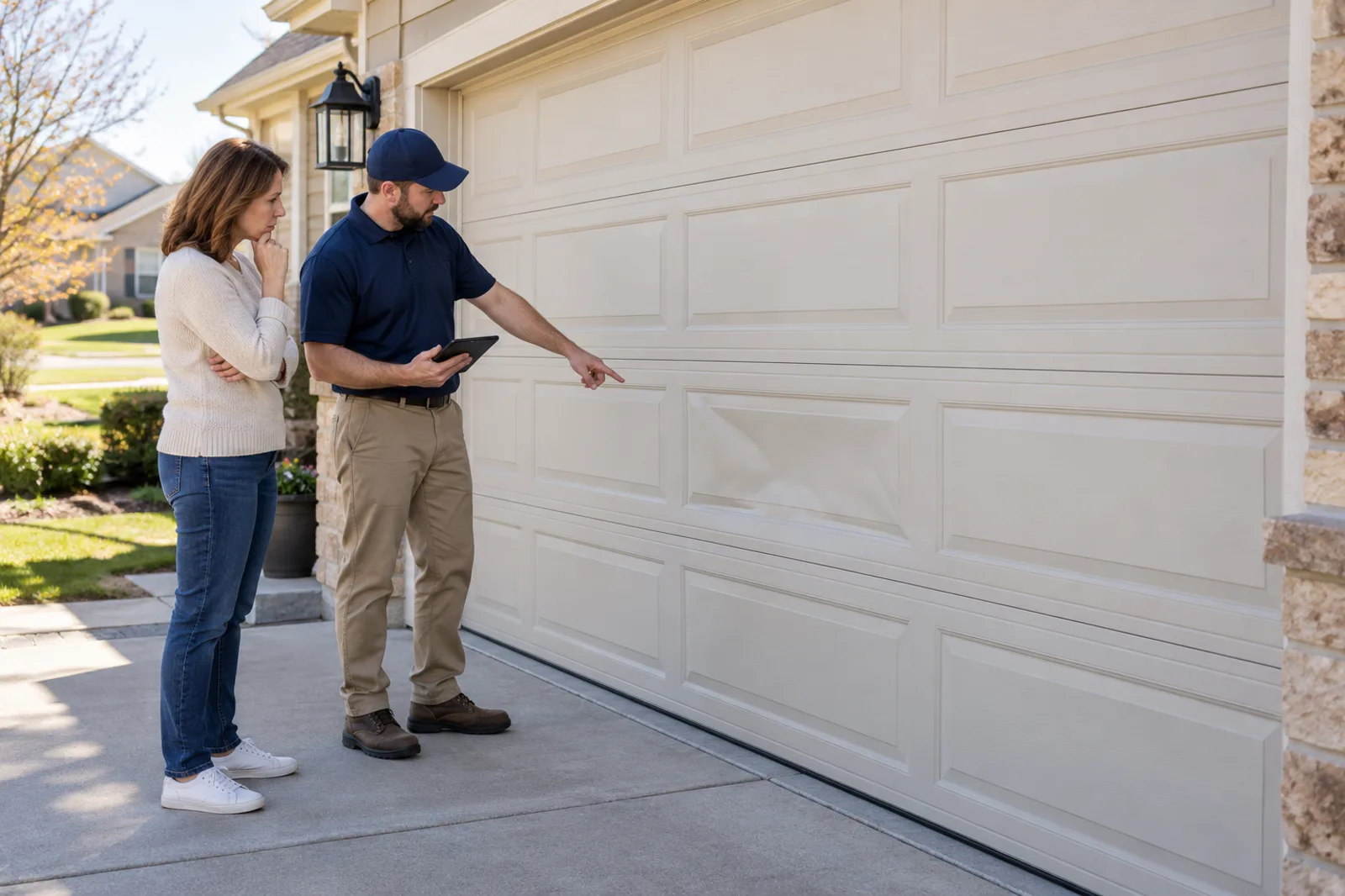
A localized panel dent may be cosmetic rather than structural. If the section remains stiff, connections are intact, rollers track correctly and a matching panel is unnecessary, the owner may choose to live with appearance damage.
When a replacement section is available and the remaining door is in good condition, section replacement can preserve the tracks and most of the door. Color and embossing may not match perfectly after years of weathering, so expectations should be clear.
Age alone is not a reason to discard a functioning system. A well-maintained older door with available parts and sound sections can be worth repairing.
Evaluate current condition, not a generic lifespan chart. The important questions are whether compatible parts can be sourced, whether the door can be balanced and tracked correctly, and whether the repaired system will meet present use without relying on multiple marginal components.
For independent guidance, review Door & Access Systems Manufacturers Association's Garage door and opener safety tips (opens in a new tab).
- Damage is limited to one identifiable component or adjustment.
- Door sections remain straight, stiff and securely connected.
- Tracks and supporting structure are serviceable.
- Compatible replacement parts are available.
- The door can be correctly balanced after repair.
- The existing door still meets functional and appearance goals.
When replacement becomes the stronger option
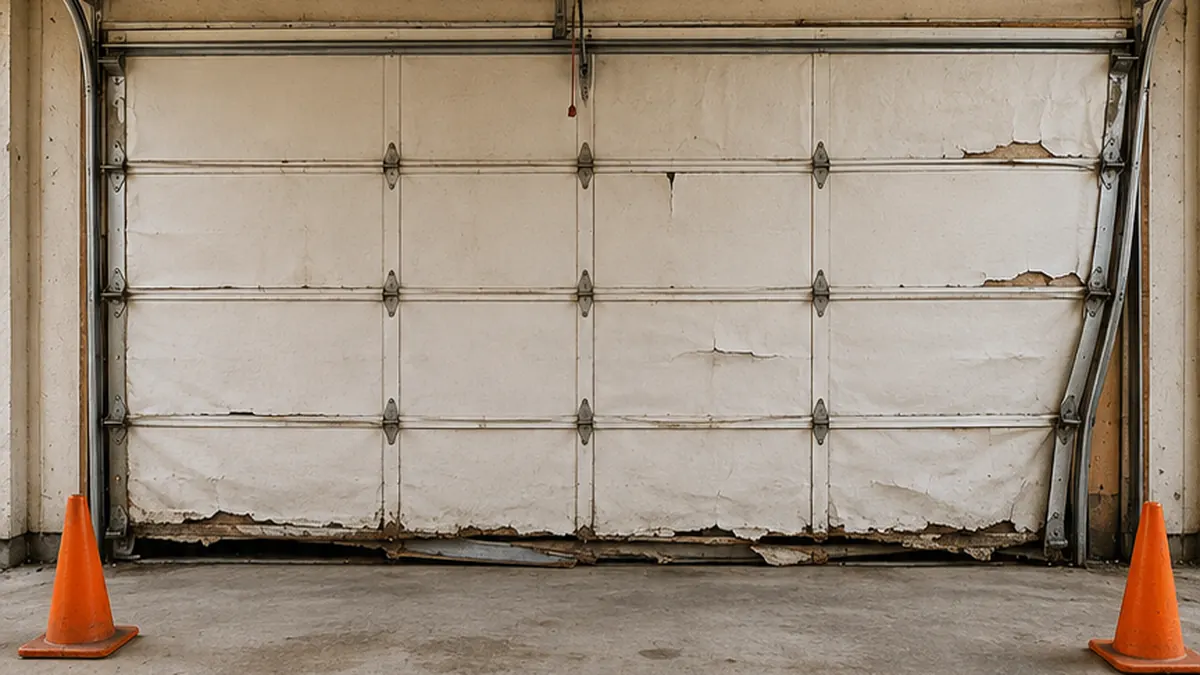
Replacement deserves consideration when the door has lost structural integrity. Deep creases across a section, separation of layers, cracked wood, widespread rust-through, damaged stile attachments or distortion around bottom fixtures can affect how forces travel through the door. A panel is not only a decorative surface; it helps the assembly remain rigid as rollers guide it through curved tracks. If this condition matches your situation, review the service scope for residential door replacement.
Widespread deterioration changes the economics. Replacing one component after another can preserve an aging system whose sections, tracks and hardware are all near the end of practical service. The issue is not simply adding invoices.
Multiple failures may interact, create downtime and make consistent balance difficult. A complete replacement can coordinate the door, tracks and counterbalance around a known weight and configuration.
Obsolete sections and proprietary parts can make repair impractical. Manufacturers change panel profiles, embossing, colors, dimensions and connection details. A section that looks similar may not safely integrate with the existing door.
When matching structural components are unavailable, improvising can create a weak or poorly tracking assembly. Replacement may be more responsible than forcing incompatible parts together.
Use a safety-first decision matrix
Put safety and structural conditions ahead of appearance and convenience. A door that can fall, leave the track or release tensioned components needs immediate professional attention.
A faded finish does not. After urgent hazards are controlled, compare the repairability of the failed part, condition of the surrounding system, availability of compatible components and likelihood of reliable operation after the proposed work.
The matrix below is not a diagnosis. It shows how different evidence should influence the conversation. One broken spring on a sound door usually points toward repair.
Multiple torn sections, distorted tracks and compromised bottom fixtures point toward broader replacement. An outdated opener may be replaced without replacing a structurally sound door, while a new opener should not be installed on an unbalanced or failing door.
Ask the provider to explain which observations drive the recommendation. 'The door is old' is not enough. Useful evidence includes measurement, section damage, parts availability, balance, track condition, hardware wear, opening requirements and current use. A transparent scope makes it easier to compare proposals that may appear similar in price but solve different layers of the system.
| Condition | Repair is more likely when | Replacement is more likely when | Priority |
|---|---|---|---|
| Spring or cable failure | Door and related hardware remain sound | Failure accompanies widespread wear or door damage | Immediate safety |
| Panel damage | One compatible section is available and structure is intact | Several sections are creased, cracked or unavailable | Structure then appearance |
| Track problem | Track is locally adjustable or replaceable | Opening or multiple tracks are distorted | Safe guidance |
| Opener problem | Door is balanced and opener fault is isolated | Door and opener are both mismatched or obsolete | Door first |
| Cosmetic aging | Owner accepts appearance and door functions well | Appearance combines with corrosion or structural decline | Planned decision |
How panel and section damage should be evaluated
A sectional door bends along hinges between sections as it travels through the curved track. Each section needs enough stiffness to span the opening and support attached hardware.
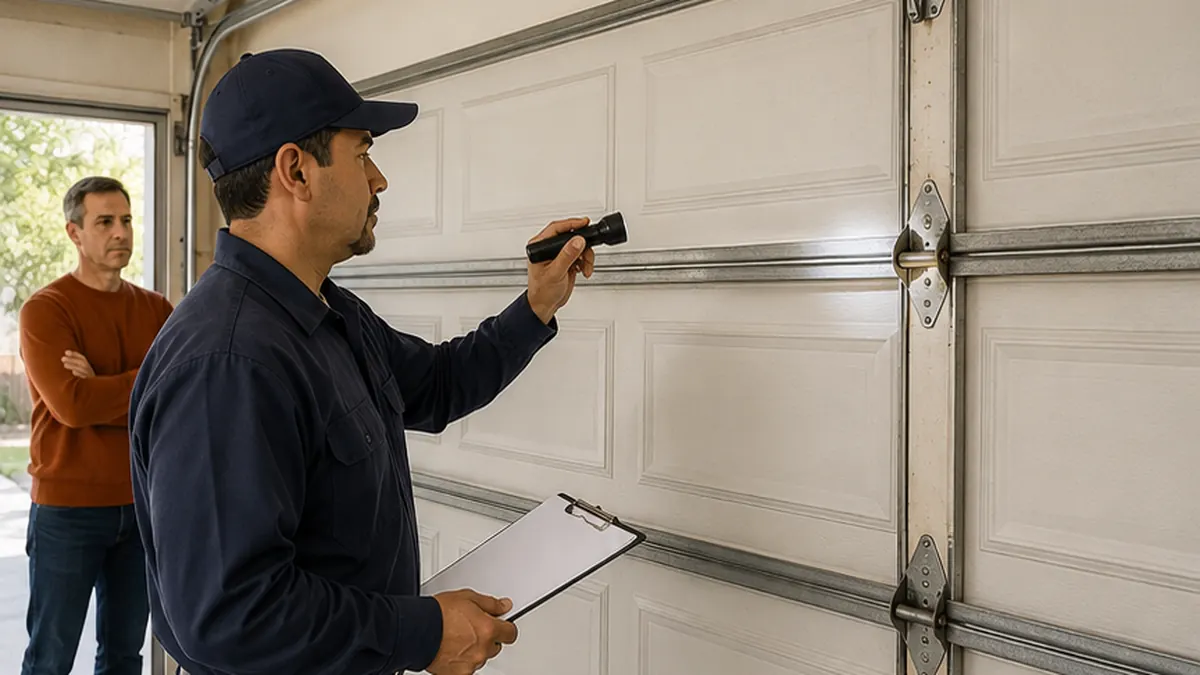
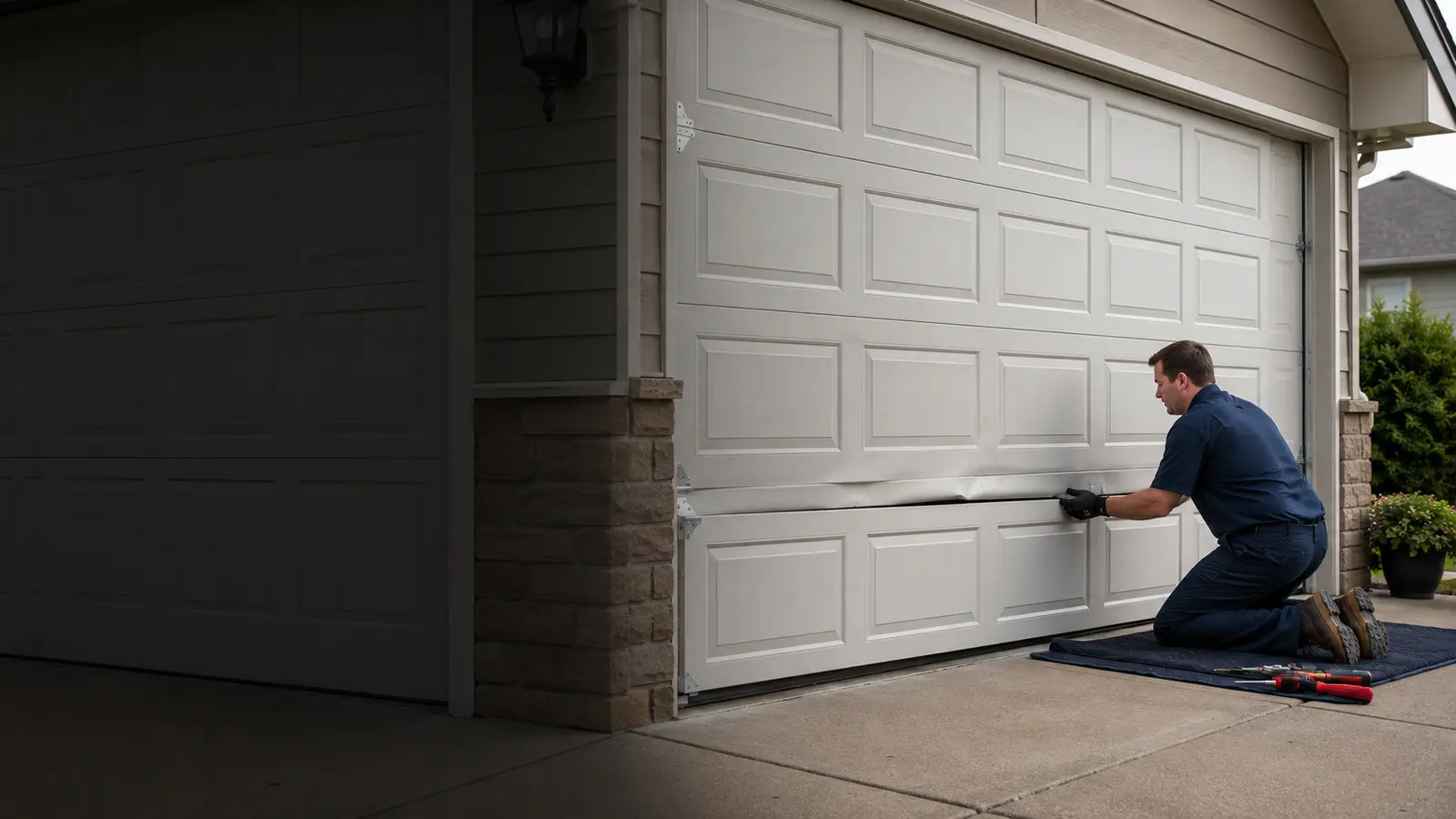
Inspect creases, cracks, separation, torn metal near hinges, loose reinforcement and deformation around roller carriers. Damage near the top section also matters because the opener arm transfers force there.
A single replacement section must match width, height, joint profile, hinge locations and compatible construction. Even when the model remains available, a new finish may differ from weathered sections. Windows, insulation and reinforcement add variables.
For some doors, refinishing a cosmetic dent may be preferable; for others, a compromised section must be replaced. There is no safe universal rule based only on dent size.
Bottom sections require special care because lift cables and bottom fixtures may be attached there under spring tension. Homeowners should not loosen bottom brackets to replace a section.
Water exposure, salt and repeated floor contact can deteriorate the bottom edge, seal retainer and fasteners. Correct the moisture or floor condition so a replacement does not inherit the same damage.
Do not judge the opener separately from the door
An automatic opener should move a properly balanced door. If the door is heavy, crooked or binding, the opener may appear weak even when its motor and controls are functional.
Replacing the operator without correcting the physical door can damage the new unit and leave unsafe movement unchanged. Balance and manual travel should be evaluated before opener capacity or failure is diagnosed.
A sound door may still benefit from an opener replacement when the operator has failed, lacks required safety features, uses unavailable parts or no longer provides the controls the owner needs. Capacity, rail length, door height and top-section reinforcement must match. Commercial operators add duty cycle, control stations, monitored safety devices and facility workflow considerations.
When replacing the door, the existing opener can sometimes remain if it is compatible, in good condition and appropriately sized. Do not assume it will.
A new door may have different weight, height, track arrangement or reinforcement needs. The installation plan should state whether the operator, rail, controls, sensors and attachment will be retained, modified or replaced.
For independent guidance, review Door & Access Systems Manufacturers Association's Garage door technical data sheets (opens in a new tab).
Balance
The counterbalance should carry the load so manual movement is controlled.
Capacity
The motor, rail and attachment must match the door height, construction and use.
Safety
Travel, reversal and monitored devices should be commissioned after mechanical work.
Insulation, seals and attached-garage comfort
Homeowners often consider replacement to improve comfort. An insulated door can reduce heat transfer through the door itself, but total performance depends on section joints, perimeter seals, floor contact, walls, ceiling and the door connecting the garage to the home.
A high advertised R-value does not correct large air gaps or an uninsulated surrounding structure. Compare construction and sealing as a system.
Attached garages deserve careful air-sealing between garage and living space. Federal building-science guidance emphasizes isolating attached garages from conditioned areas through continuous air barriers and weather stripping at connecting doors.
A new overhead door may improve perimeter leakage, but it is not a substitute for addressing the shared wall, ceiling and house-entry door. Never run vehicles or combustion equipment in an enclosed garage regardless of insulation.
For Wichita weather, consider sun exposure, wind, temperature swings and how often the door is open. An insulated door may help moderate an attached workspace or room above, but frequent opening dominates short-term air exchange.
Choose durable seals suited to the floor and opening. If the slab is uneven, a new bottom seal alone may not close every gap without additional correction.
| Factor | What it affects | What to inspect |
|---|---|---|
| Section insulation | Heat flow through door panels | Construction, thickness and thermal breaks |
| Perimeter seals | Air, dust and water entry | Top, sides, corners and floor contact |
| Attached-garage separation | Air movement toward living space | Shared walls, ceiling and house-entry door |
| Windows | Daylight, appearance and thermal performance | Glazing, seals and placement |
| Usage | Real-world temperature swings | Daily cycles and how long the door remains open |
Appearance, curb appeal and practical design
The garage door can occupy a large portion of a home's street-facing elevation, so appearance is a legitimate replacement factor. Panel design, color, windows and hardware can change the character of the property. Keep design choices compatible with architecture, maintenance tolerance and neighborhood context rather than following a short-lived trend.
Windows add daylight but also affect privacy, section weight and replacement availability. Decorative hardware should not interfere with movement or create snag points.
Dark colors can absorb heat, and finish performance depends on material and exposure. Ask about maintenance, repainting and warranty limitations before choosing a surface solely from a small sample.
For commercial properties, appearance may be secondary to durability, visibility, clearance and workflow. Glazed sections can provide line of sight; insulated sections can support conditioned operations; high-lift tracks may preserve ceiling space where the building allows. The correct design begins with the opening and use, not a residential catalog image applied to a service bay.
What full replacement should include
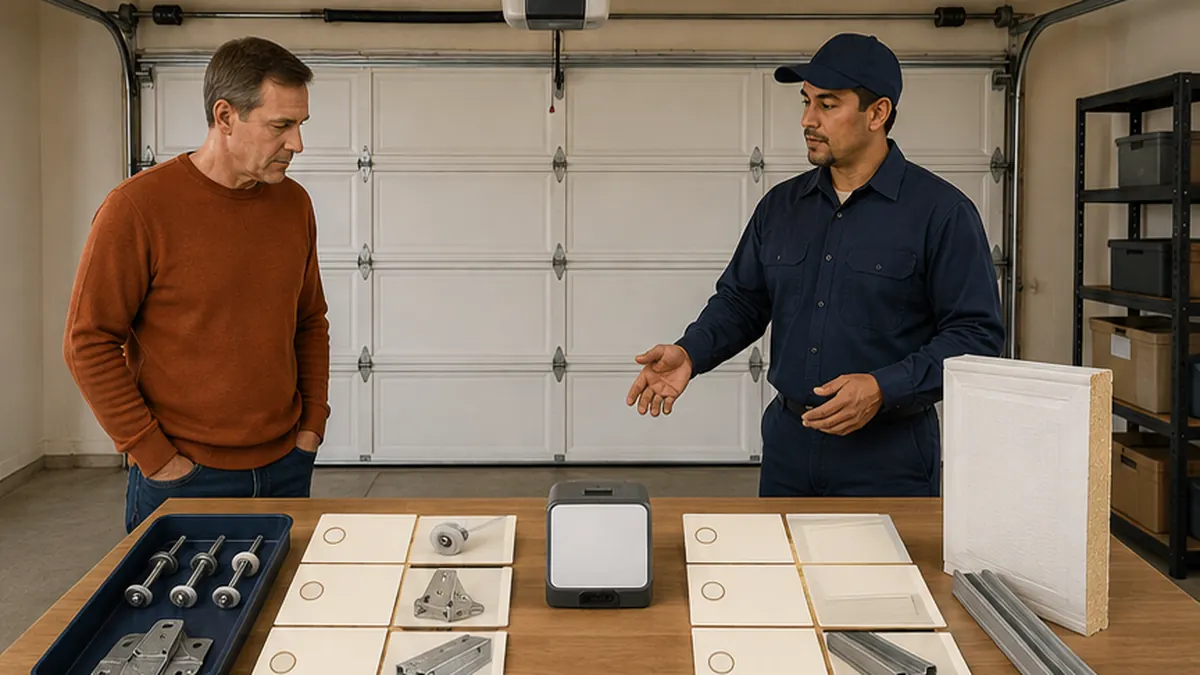
A complete door replacement begins with field measurements of the finished opening, sideroom, headroom, backroom and floor. Framing and attachment surfaces must support tracks and spring anchors.
Ceiling obstructions, lights, storage, ducts and existing opener rails can affect layout. Ordering from nominal measurements without checking the actual opening risks poor fit and installation changes.
The scope should identify the door sections, track, rollers, hinges, counterbalance, seals and reinforcement. It should explain what existing hardware will be removed or retained and whether disposal is included.
If the opener remains, compatibility and attachment should be confirmed. If a new operator is included, specify controls, sensors and commissioning.
After installation, the door should move smoothly, remain properly tracked and demonstrate appropriate balance before automatic operation. Seals should contact reasonably without creating excessive drag.
The opener's travel and safety functions should be set for the completed door. The owner should receive operating and maintenance guidance rather than only a demonstration of the remote.
- Verified finished-opening and clearance measurements
- Door construction, design, insulation and window selections
- Compatible tracks, springs, rollers and hinge package
- Structural backing and attachment requirements
- Perimeter and bottom sealing approach
- Existing-opener compatibility or new operator scope
- Removal and disposal of replaced components
- Balance, travel, reversal and control commissioning
How to compare proposals without chasing the lowest number
Make sure proposals solve the same scope. One may quote a section replacement while another includes a complete door, tracks and counterbalance. One may retain the opener, while another includes a new unit and controls.
Compare door construction, insulation, windows, track type, spring design, seals, removal, electrical responsibility, permits and finish work. A lower total can be appropriate, but only after differences are visible.
Ask what conditions could change the price after work begins. Hidden framing damage, nonstandard openings, incompatible wiring and obsolete hardware may require adjustments. A site assessment should reduce surprises.
Avoid vague promises that every existing component will work with the new door. Compatibility should be verified, not assumed.
Consider downtime and serviceability. For a business, a door that blocks vehicles or deliveries has operational cost. Product availability, lead time and local parts support can matter as much as headline efficiency.
For a home, the ability to obtain a future replacement section or seal may influence value. Choose a solution the property can maintain, not merely install.
| Scope item | Proposal A | Proposal B | Question to resolve |
|---|---|---|---|
| Door and sections | Model and construction | Model and construction | Are insulation and reinforcement equivalent? |
| Track and springs | Included or retained | Included or retained | Is the counterbalance sized for the selected door? |
| Opener | Retain, modify or replace | Retain, modify or replace | Who verifies capacity and safety controls? |
| Removal | Included or excluded | Included or excluded | What happens to old materials? |
| Finish work | Framing, power and patching | Framing, power and patching | Which trade owns each item? |
Prepare useful information for an assessment
Share the door location, residential or commercial use, approximate width and height, material and number of sections. Describe the failure and whether the door is open, closed, crooked or off track.
Mention a trapped vehicle, broken spring, loose cable or impact so the request can be prioritized correctly. Do not move an unsafe door to take measurements.
Photograph the full door from inside and outside, the spring and shaft area, both tracks, opener, damaged sections and any labels. Include a side view of creases and a wider view showing the opening.
If considering replacement for comfort or appearance, share window, color, insulation and use priorities. For commercial doors, add cycle volume, vehicle clearance, controls and downtime constraints.
Ask for both repair and replacement pathways when both are reasonable. A good assessment can explain what repair preserves, what it cannot solve and how long-term serviceability differs.
Heartland coordinates requests in Wichita and surrounding areas, with acceptance depending on location, project type and independent-contractor availability. Exact address or ZIP code, door condition and clear photos help route the request.
Frequently asked questions
Questions readers ask
Is it better to repair or replace a garage door?
Repair is usually better for a localized failure on a sound, serviceable system. Replacement becomes stronger when damage is structural, widespread, obsolete or combined with changing insulation, clearance or operating needs.
Does a broken spring mean I need a new garage door?
Usually not. If the door, tracks and related hardware are sound, a correctly diagnosed spring repair may restore operation. The complete system should still be inspected.
Can one damaged garage door panel be replaced?
Often, when a compatible section is available and the remaining door is structurally sound. Joint profile, dimensions, hardware locations, color and reinforcement must match.
Can I keep my existing opener with a new door?
Sometimes. The opener's condition, capacity, rail, controls, safety features and attachment must be compatible with the new door's height, weight and track arrangement.
Will an insulated garage door make the garage comfortable?
It can reduce heat transfer through the door, but walls, ceiling, perimeter gaps, the house-entry door and frequency of opening also determine comfort.
Should I replace a garage door because it is noisy?
Noise alone is not enough. Worn rollers, hinges, opener parts, track issues or balance can often be repaired. Structural damage and widespread wear may support replacement.
Can a bent garage door be straightened?
Minor nonstructural damage may be repairable, while deep creases, torn attachment points and distorted sections may not regain safe stiffness. The section and connected hardware need inspection.
What measurements are needed for a replacement door?
Finished opening width and height, sideroom, headroom, backroom, floor condition and structural backing are important. Final field measurements should be verified before ordering.
How long should a garage door last?
There is no universal life. Construction, environment, cycles, impacts, maintenance and part availability matter more than a simple calendar estimate.
Does Heartland replace commercial garage doors?
Heartland evaluates supported residential and commercial replacement requests in Wichita and surrounding areas, subject to opening, door type, project scope and availability.
The right solution depends on the specific lock, door, vehicle or garage door system. Check the Wichita-area service pages, then call or send the details for an evaluation.