Garage door replacement
Choosing a New Garage Door: A Wichita Homeowner’s Practical Checklist
A new garage door is a large moving wall, not a paint color with hinges. It needs to fit the opening, operate safely with its tracks and springs, work with the opener, keep out ordinary weather, and look right on the house for years. The brochure can wait for five minutes: start with what the opening and household actually need, then compare doors and proposals on the same facts.
Choose a new garage door by confirming the opening, clearance, framing and operating needs first. Then compare construction, insulation information, windows, reinforcement, finish, seals, counterbalance, tracks, opener compatibility and the complete installation scope. Do not select from appearance alone or accept a door-only price that omits hardware, removal, adjustment, testing and warranty details.
A new garage door is a large moving wall, not a paint color with hinges. It needs to fit the opening, operate safely with its tracks and springs, work with the opener, keep out ordinary weather, and look right on the house for years. The brochure can wait for five minutes: start with what the opening and household actually need, then compare doors and proposals on the same facts. Continue with the complete library of garage door replacement guides when you want to compare related decisions.
Key takeaways
- Confirm the opening and clearance before choosing a style or window pattern.
- Compare complete installed systems, not door panels in isolation.
- Section R-value and whole-door U-factor are not interchangeable claims.
- Use written specifications for weather, finish, attachment and safety scope.
- Require balanced operation and a documented safety handoff.
Start with the opening, not the catalog cover
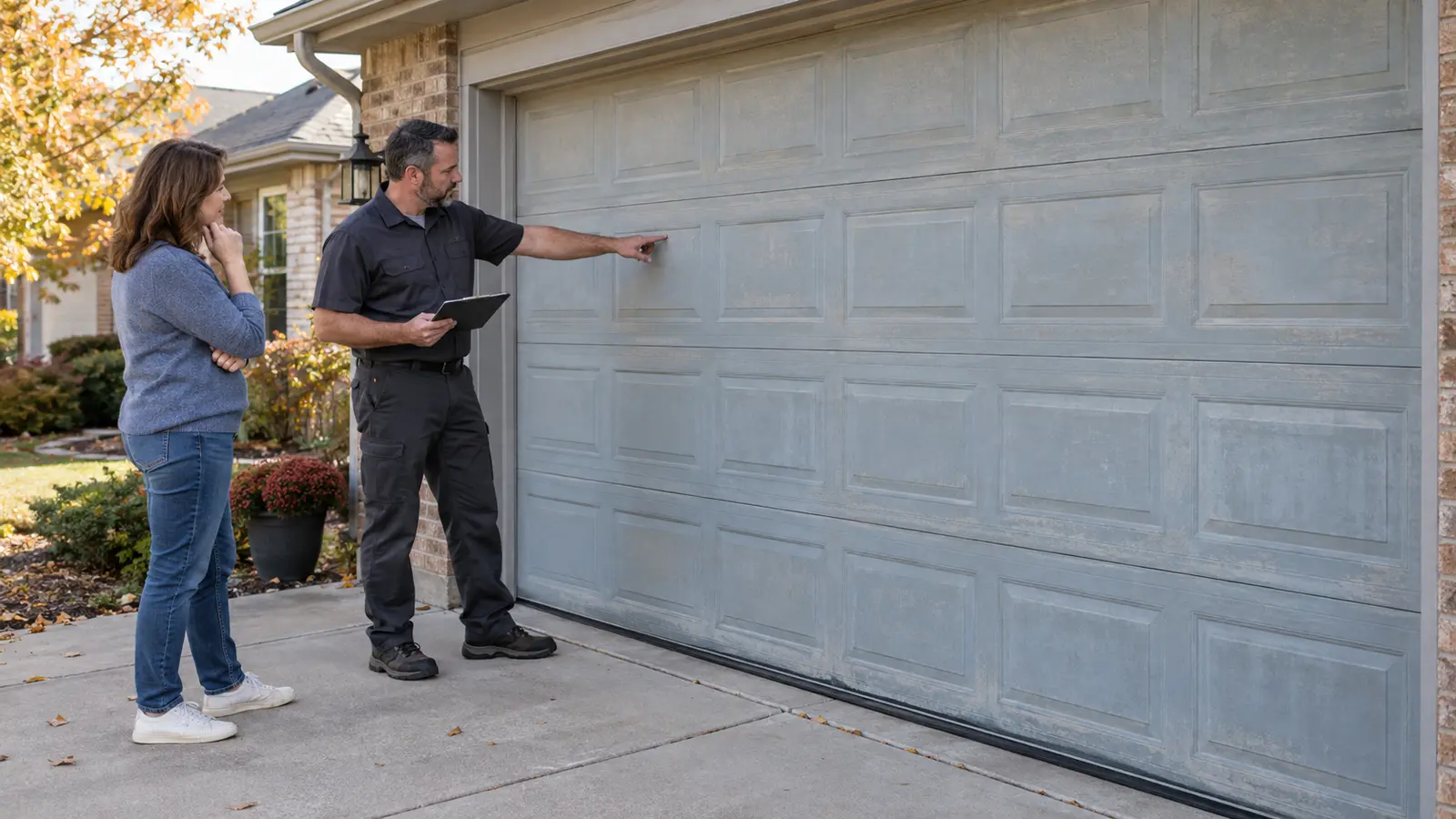
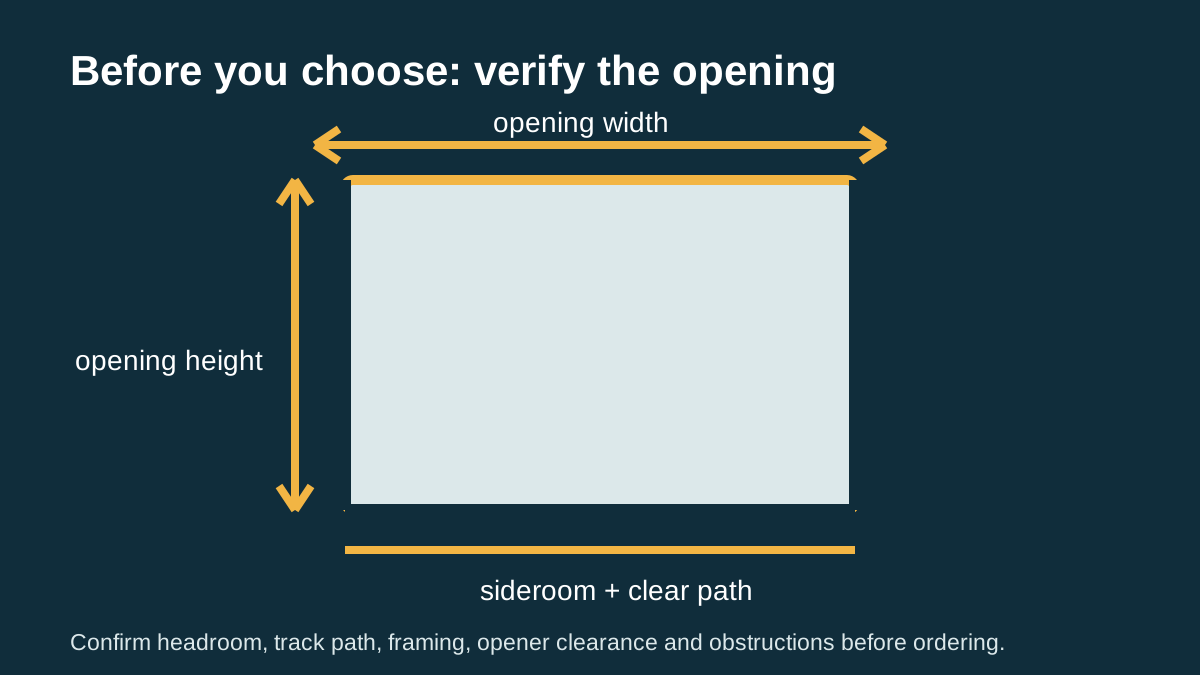
A garage door only performs as well as the opening and supporting structure allow. Before comparing panel styles, a technician should confirm opening width and height, headroom, sideroom, backroom, jamb condition, ceiling obstructions, electrical equipment, opener location, and the route the new tracks will follow. A handsome door cannot compensate for loose backing, damaged masonry attachment, water-damaged trim, an out-of-square opening, or clearance that does not support the selected track arrangement. If this condition matches your situation, review the service scope for garage door replacement options.
Give the provider the practical facts that affect scope. Is the garage attached to the home? Is there a bedroom above it, a workshop inside it, a low ceiling, storage racks, a beam, a lift, or an opener you hope to keep?
Does the door serve as the household's usual entrance? Those answers turn a generic quote into a specification that can be checked.
Do not take down the old door, loosen tracks, or touch springs, cables, drums, or bottom brackets to obtain measurements. Safe wide photographs of the closed door, inside track layout, and labels reachable from the floor are useful. Dismantling is not a homeowner planning step.
Opening and clearance
Confirm dimensions, headroom, sideroom, backroom, jamb condition and obstructions before selecting a system.
How the household operates it
Frequency, attached-space comfort, noise, vehicle access and opener needs affect the right configuration.
What the installer must correct
Separate a new-door selection from needed framing, trim, track or electrical work.
Choose construction for the job the door has to do
Steel sectional doors are common because they can offer durable skins, many finishes, insulation options, window layouts and broad availability. But 'steel door' is not a complete specification.
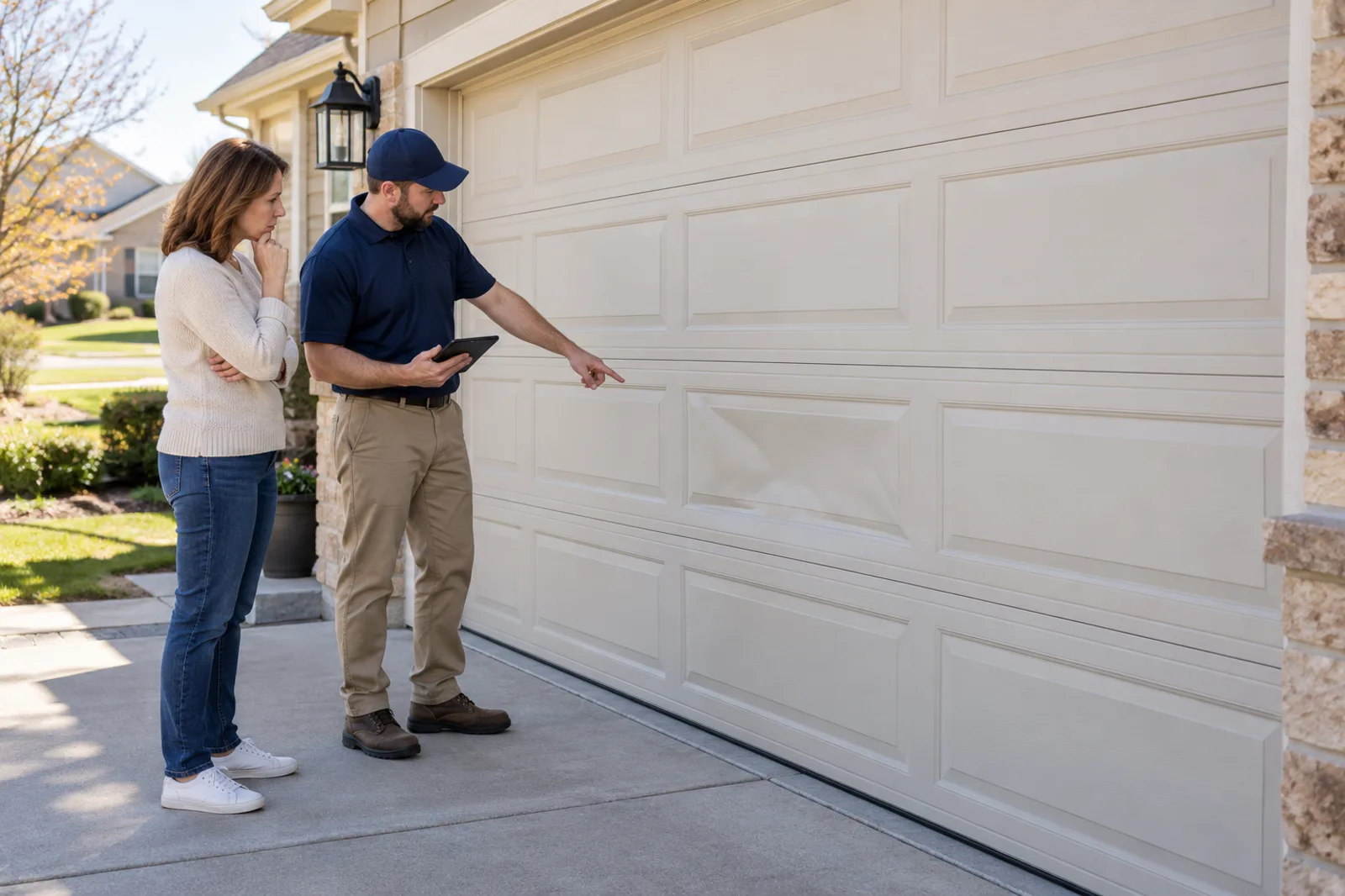
Compare the section construction, face material, backing, insulation type, joint design, reinforcement, finish care and future repair path. A non-insulated pan section and a well-built insulated sandwich section do not perform or feel the same in use. If this condition matches your situation, review the service scope for garage door panel repair.
Wood, aluminum, fiberglass, glass and specialty designs can be appropriate, but each changes the conversation about weight, finish upkeep, corrosion, glazing, impact resistance, cost and serviceability. The aim is not to declare one material universally best. It is to match a documented product to the opening, weather exposure, architecture and maintenance level the owner will actually sustain.
For an attached garage or workspace, insulation and air sealing may deserve more weight. Ask what number is being quoted: a section R-value describes resistance through a section, while a whole-door U-factor addresses heat transfer through an assembly.
Windows, joints, perimeter seals, walls and the door into the house also affect the real result. A door can be an important improvement without becoming a magic fix for every comfort problem.
| Feature | Useful question | Why it matters |
|---|---|---|
| Sections | What are the face, backing, insulation and joint construction? | Construction affects stiffness, maintenance, feel and thermal performance. |
| Insulation | Is the number R-value or whole-door U-factor? | Marketing figures describe different things and should not be compared as if identical. |
| Finish | What care and exclusions apply? | Exposure and cleaning expectations affect long-term appearance. |
| Future service | Are sections, seals and compatible hardware supported? | Availability matters when normal wear or accidental damage eventually occurs. |
Treat windows, style and color as performance choices
A garage door can occupy a large part of the front elevation, so appearance is a valid factor. Panel profile, window shape, glass treatment, hardware and color should relate to the house rather than chase a short-lived trend.
Review a full elevation photo and look at the door from across the street as well as from the driveway. A design that is attractive in a showroom can still overpower a low roofline or compete with the front entry. If this condition matches your situation, review the service scope for residential garage door replacement.
Windows add daylight but also change privacy, glare, heat transfer, cleaning and replacement planning. Ask how the selected glazing affects reinforcement, lead time and service options. Get a physical finish sample or manufacturer reference when matching siding, brick or trim matters; a screen image cannot guarantee an exact result.
Specify the complete operating system
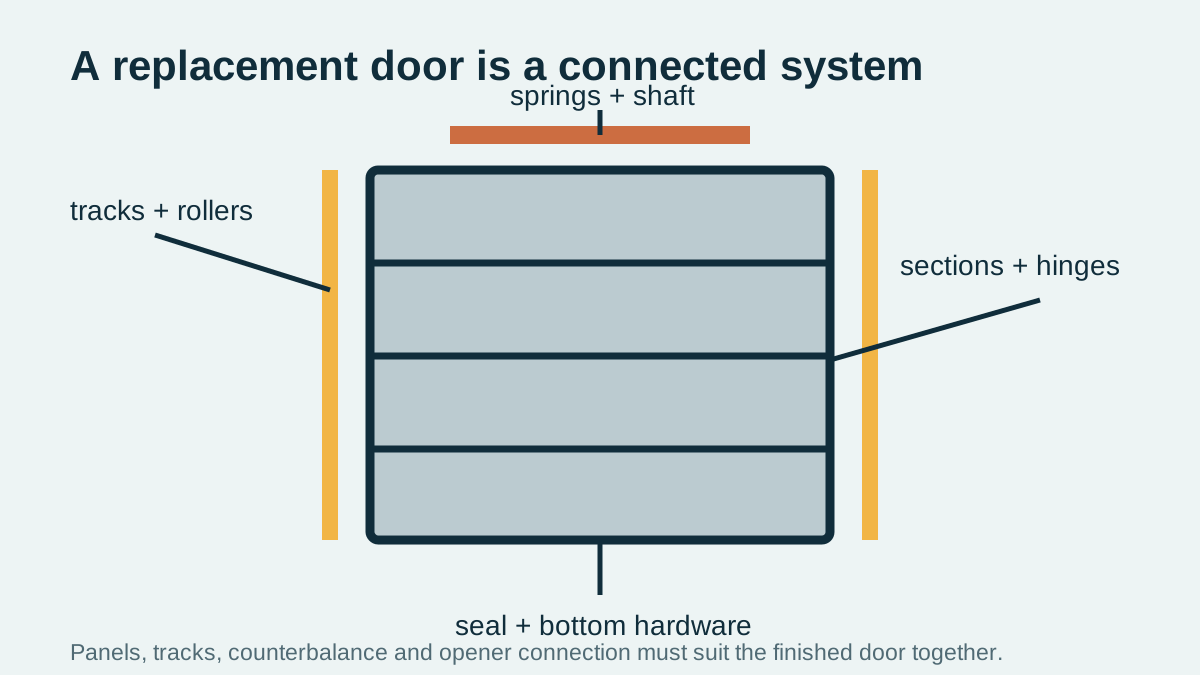
The visible sections are only one part of a garage-door system. Correct tracks, rollers, hinges, struts, lift cables, drums, bearings, springs, brackets, bottom seal, perimeter weatherstripping and opener connection all need to suit the actual door and opening.
A heavier door, glazing, reinforcement or a different track arrangement can change counterbalance requirements. Springs must be selected for the assembled door, not reused simply because the old one moved.
If you plan to keep the opener, have compatibility evaluated early. The opener does not replace a properly balanced door; it moves a door that is already mechanically sound.
The rail, trolley, attachment point, travel limits, force settings, emergency release, photo eyes and controls must be checked with the new configuration. If it is aging, undersized or unsupported, compare a separate replacement option rather than assuming it belongs in the door quote.
A complete installation includes smooth travel, balance, cable tracking, fastener and track checks, opener connection and relevant safety-function verification. The DASMA garage-door safety guidance (opens in a new tab) is a useful boundary: high-force components are not casual adjustment points. The desired result is boring—a door that travels evenly and does not need a dramatic remote-button demonstration to prove itself.
- Identify the exact door model, size, construction, finish and windows.
- Confirm matched tracks, rollers, hinges, struts, springs, cables and seals.
- State whether the opener is retained, adjusted, replaced or excluded.
- Include balance verification and protective-device checks.
- Require manuals, product records and written warranty information at handoff.
Plan for Wichita weather with specifications, not slogans
Temperature swings, wind-driven rain, hail and sun exposure are real considerations, but 'built for Kansas weather' is not a useful product specification. Ask the provider to identify manufacturer requirements that apply to the particular opening, including track and jamb attachment, reinforcement options, seal details, finish guidance and any local requirements. The right answer depends on the home, opening, product and installation—not a generic regional label.
Weather sealing deserves a visual check after installation. Bottom, side and top seals should meet the door and opening without making the door bind.
Seals reduce ordinary air, dust and water entry, but they cannot correct drainage problems, a damaged slab, missing flashing, poor exterior grading or a seriously out-of-square opening. State those separate conditions in the proposal so a door purchase does not become a promise to solve work outside its scope.
Keep the manufacturer model, color, section description and installation record. That paperwork feels unglamorous until a vehicle, storm debris or a wayward basketball makes a future repair discussion very precise.
Compare proposals line by line before approving one
A door-only price is not a comparable installation estimate. Request the manufacturer and model, size, construction, finish, insulation information, windows, hardware, tracks, springs, reinforcement, seals, opener work, labor, removal, disposal, tax, lead time, warranty provider and exclusions. If one proposal includes a new track system and final adjustment while another lists only the door, the lower number is not proof that the same work costs less.
Separate required restoration from optional upgrades. Windows, decorative hardware, premium finishes, higher-cycle springs, new controls and opener upgrades may be good choices, but show them distinctly so the decision is clear. If framing, trim, electrical or masonry attachment needs correction, state whether it is included, excluded or assigned to another qualified trade.
Do not accept 'it goes up and down' as the final test. CPSC guidance for automatic garage-door openers underscores the value of compliant entrapment protection and correct operation. At handoff, see normal travel, understand the emergency release, verify relevant safety features, receive manuals and warranty details, and ask what ordinary maintenance is appropriate.
| Include in writing | Why it belongs |
|---|---|
| Exact product and configuration | Prevents a price from drifting away from the model, finish, windows or insulation you compared. |
| Complete hardware and counterbalance scope | A new door must operate as a matched system, not on assumptions about old components. |
| Opening and attachment work | Makes clear whether necessary structural or trim corrections are priced or excluded. |
| Removal, disposal, tax and schedule | Avoids false savings and makes the total installed cost visible. |
| Testing, records and warranty | Creates a documented closeout and clear point of contact if a problem appears. |
Prepare a focused Wichita replacement request
Begin with a wide photo of the closed door and a second view from inside showing the track path and opener area. Add close photos of reachable product labels, visible damage, water entry, trim or jamb concerns, and any existing obstruction. Do not climb ladders, stand beneath a raised door, remove hardware or rearrange tensioned parts for a better photo.
List the decision priorities in order: safe replacement after damage, appearance, insulation, quieter operation, daylight, low maintenance, storm exposure, preserving an existing opener, or timing tied to other exterior work. A technician can provide better options when the homeowner says which tradeoffs are real.
Heartland can help route a Wichita-area garage-door replacement request based on door type, opening, location and current availability. Share the facts first, request an itemized scope, and compare the completed system you will own—not merely the image that caught your eye.
Frequently asked questions
Questions readers ask
What should I consider before buying a new garage door?
Start with the opening, clearance, framing, daily use, construction, insulation information, windows, finish, weather sealing, system hardware, opener compatibility and complete installation scope. Compare proposals using the same facts.
Is an insulated garage door worth it?
It can be useful for an attached garage, workspace, noise goals or comfort concerns, but compare what the insulation number means and consider the complete garage envelope. Walls, ceiling, windows, seals and the house-entry door also affect practical comfort.
Can I keep my existing garage-door opener with a new door?
Possibly, if it is compatible and in good condition. The new door must be mechanically balanced and the opener rail, attachment, travel, force settings and protective functions must be evaluated with the completed system.
How do I compare garage-door replacement estimates?
Compare exact product details, tracks, springs, hardware, seals, opener work, opening corrections, labor, removal, disposal, tax, lead time, testing, warranty and exclusions. Do not compare a door-only price against a complete installed scope.
Does Heartland handle garage-door replacement requests in Wichita?
Heartland handles supported garage-door replacement requests in Wichita and surrounding areas, subject to the opening, door type, scope, location and current availability.
The right solution depends on the specific lock, door, vehicle or garage door system. Check the Wichita-area service pages, then call or send the details for an evaluation.