Commercial locksmith
Master Key Systems for Wichita Businesses: Planning Access by Role
A useful master key system is not simply one key that opens everything. It is a planned hierarchy that gives each job role the access it needs while limiting the effect of a lost key, staff change, or future expansion. For a Wichita business, the quality of that plan depends less on the number of keys ordered than on the door inventory, role map, hardware compatibility, approval process, and records that support the system after installation.
Plan a master key system from the business outward: inventory every opening, group access by stable job role, reserve broad keys for the few people who truly need them, confirm cylinders and keyways can support the hierarchy, and document issue and return procedures. Compare proposals by door, access level, credential quantity, hardware work, testing, and closeout—not by a single per-cylinder price. The finished system should let authorized people move efficiently without turning every employee key into an all-access credential.
A useful master key system is not simply one key that opens everything. It is a planned hierarchy that gives each job role the access it needs while limiting the effect of a lost key, staff change, or future expansion. For a Wichita business, the quality of that plan depends less on the number of keys ordered than on the door inventory, role map, hardware compatibility, approval process, and records that support the system after installation. Continue with the complete library of commercial locksmith guides when you want to compare related decisions.
Key takeaways
- Start with named doors and job roles before deciding how many master levels the system needs.
- Give each role the narrowest practical access and issue high-level keys only to accountable custodians.
- Confirm keyway, cylinder, core, lock, and landlord or corporate compatibility before ordering hardware.
- Plan for turnover, lost keys, future doors, tenants, and departments while the hierarchy is still easy to change.
- Close out with door-by-door testing, a counted credential handoff, and protected records for future service.
Begin with the business problem, not an all-access key
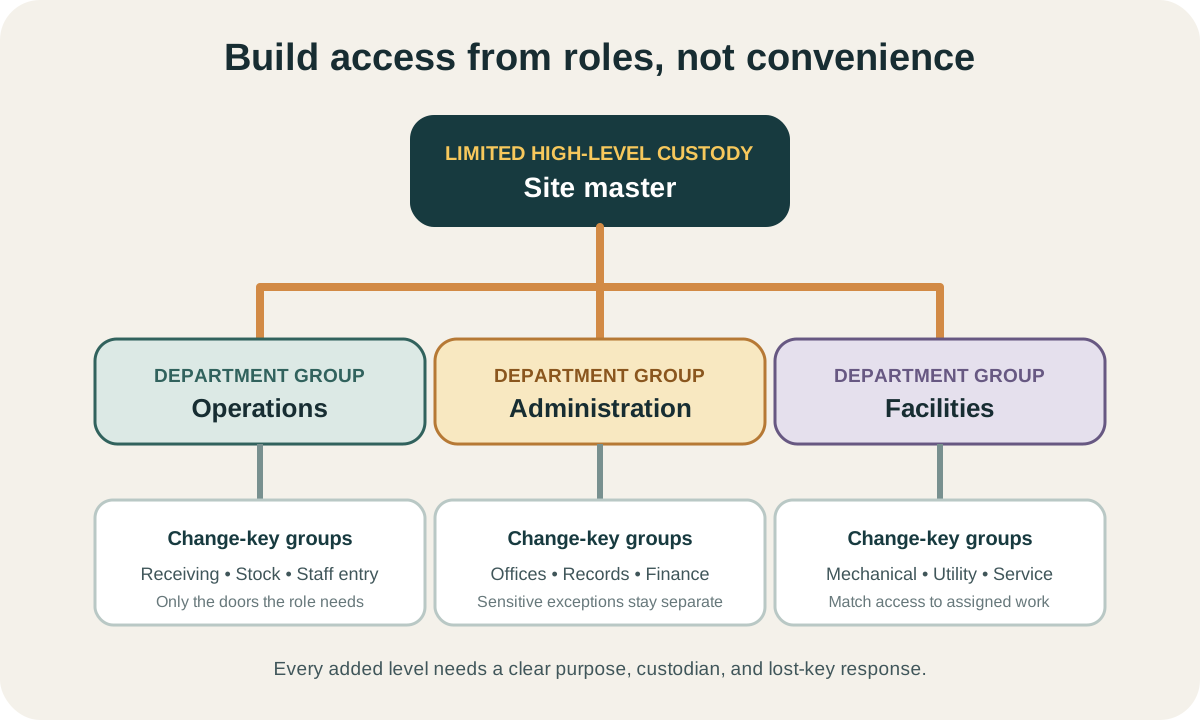
Businesses usually consider a master key system because daily access has become awkward. Managers carry crowded rings, departments share poorly labeled keys, an owner must meet every service vendor, or years of lock changes have created several unrelated keyways. A well-designed hierarchy can reduce that friction, but convenience alone is not enough; the same structure must keep a limited employee key from opening areas outside that person's work. If this condition matches your situation, review the service scope for master key systems.
The planning question is therefore not, 'Which key should open every door?' It is, 'Which stable roles need which openings, and how much consequence follows if each credential is lost?' A broad master key may be useful for an owner, facilities manager, or authorized emergency custodian, while a receiving employee, bookkeeper, cleaner, or tenant may need a much narrower group.
Define the expected result in plain language before discussing cylinders. Examples include reducing five supervisor keys to one, separating office access from inventory access, preserving landlord entry, giving department leads only their assigned wing, or preparing a growing site for future doors. Those outcomes let a locksmith test whether the proposed hierarchy is solving the actual operating problem instead of merely creating a more complicated key chart.
Reduce unnecessary key-ring friction
Combine access only where a real job role repeatedly needs the same group of openings.
Limit the reach of routine keys
Keep ordinary employee credentials inside the smallest practical area for that role.
Prepare for the next change
Leave room for turnover, a new department, another suite, or a future controlled opening.
Inventory every opening before drawing the hierarchy
Give each door a stable identifier such as Front-01, Office-04, Records-02, or Receiving-01. Record its location, function, normal users, public or staff status, traffic level, lock and cylinder type, keyway where appropriate, and any connection to exit hardware or electronic access. A consistent schedule prevents a side office or seldom-used service door from being discovered after cylinders have been ordered. If this condition matches your situation, review the service scope for commercial locksmith services.
Inspect the complete opening rather than assuming a key-system project is only about key combinations. Binding latches, loose trim, worn cylinders, sagging doors, damaged strikes, and unreliable closers can make a correctly keyed lock feel defective. The ANSI/BHMA product grade information (opens in a new tab) explains that product grades represent progressive performance benchmarks, which is useful context when matching replacement hardware to traffic and duty rather than choosing by appearance alone.
Mark doors controlled by a landlord, franchise standard, corporate specification, fire or life-safety plan, or another party. A tenant may not have authority to rekey a shared vestibule, and a local manager may not own the restricted keyway used across several locations. Resolve those relationships before the technician arrives so a local convenience project does not break building access or violate an existing system agreement.
| Field | What to record | Why it matters |
|---|---|---|
| Door identity | Stable ID, location, and normal function | Keeps scope, testing, and future service tied to the same opening |
| Authorized roles | Who needs routine, occasional, or emergency access | Provides the basis for access groups |
| Installed hardware | Lock, cylinder or core, keyway, trim, exit hardware, and condition | Reveals compatibility and repair needs |
| Ownership | Business, landlord, corporate, or shared control | Confirms who may approve changes |
| Operating limits | Hours, deliveries, public traffic, alarms, and service windows | Shapes installation sequence and handoff |
Translate job roles into access groups
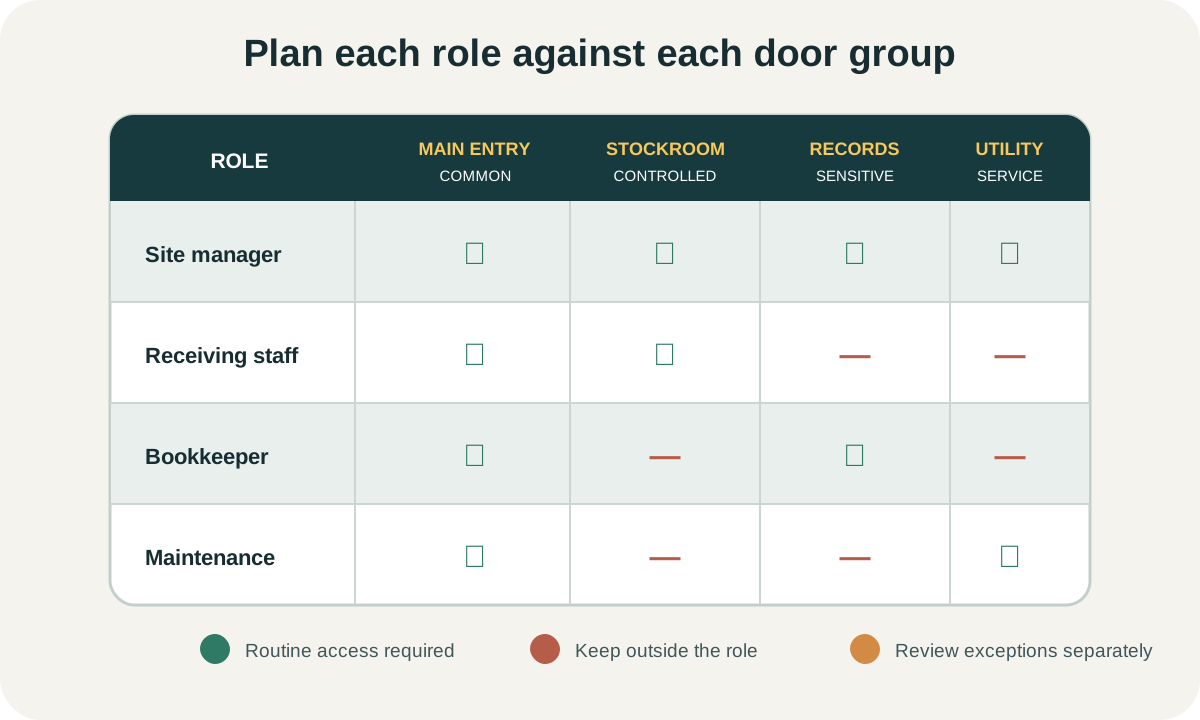
Role-based planning is more durable than designing around individual names. Employees change, but functions such as owner, general manager, department lead, receiving, maintenance, cleaning, and tenant tend to remain understandable. List the openings each role needs on a normal workday, then review exceptions separately instead of automatically expanding the whole group for one unusual task. If this condition matches your situation, review the service scope for commercial lock repair.
A door-and-role matrix makes overlap visible. If every department lead needs the main entrance and break room but only one lead needs the records room, those common doors can belong to the department-lead group while records access stays separate. The matrix also exposes unnecessary privileges, such as a delivery key that opens executive offices simply because the doors were once keyed alike.
Plan for time and supervision even in a mechanical system. A vendor who visits twice a year may not need a permanent key if an authorized employee can provide controlled entry, while an after-hours cleaning team may need a defined set that excludes inventory or record storage. The goal is practical access, not the greatest possible number of theoretical key combinations.
- List stable job roles before employee names or key quantities
- Mark routine, occasional, supervised, and emergency access separately
- Question every exception that adds a sensitive room to a broad group
- Identify doors shared with landlords, tenants, vendors, or neighboring departments
- Assign one approver who can resolve conflicts between convenience and control
Understand the key levels without overbuilding them
A change key generally operates one cylinder or one intentionally keyed-alike group. A sub-master may operate several change-key groups within a department, and a master key may operate several departments or zones. Larger systems can include another level above those, but each added layer increases planning, recordkeeping, and the potential effect of a lost high-level key.
More levels do not automatically make a system more secure. An elegant two-level plan that everyone understands may be safer to administer than a deep hierarchy with unclear ownership and too many broad credentials. Ask what operational decision each level supports and remove any level that exists only because the system can technically provide it.
Avoid publishing sensitive hierarchy or bitting information in general staff documents. Everyday records can show key IDs, access groups, issued quantities, recipients, approvals, and returns without displaying the technical details used to create combinations. Keep the protected system record with an accountable custodian and authorized service provider rather than attaching it to a door list shared across the company.
Treat broad keys as concentrated risk
A high-level key turns many separate openings into one shared risk event. Losing an office key may affect one room, while losing a master that operates exterior doors, storage, and management areas can require a much wider response. That does not make master key systems inherently inappropriate; it means credential level must be part of every lost-key and turnover decision.
Limit high-level keys to the few roles that need them, serialize or otherwise identify issued credentials, and obtain acknowledgment at handoff. Do not hide a master key in an obvious desk, labeled cabinet, vehicle console, or exterior location, and do not attach an address or complete access description to a ring that could be found away from the property. Spare credentials need the same custody standards as daily ones.
Write the response before a key disappears. The plan should identify who receives the report, who can authorize urgent changes, which door schedule maps the key's reach, what temporary controls are available, and how the final decision will be documented. A calm, predetermined process is more useful than trying to reconstruct the hierarchy during an employee dispute or after-hours loss.
Know every door the key may operate
The response starts with credential level and affected openings, not the place where the ring was last seen.
Count high-level credentials
Issue broad keys to named custodians and document return, replacement, and exception handling.
Decide who can act
Preauthorize reporting, assessment, temporary control, and rekey decisions before an urgent event.
Use least privilege as a practical planning test
The NIST definition of least privilege (opens in a new tab) describes limiting users to the minimum access needed for assigned tasks. NIST applies the concept to information systems, but the planning test translates well to mechanical access: a key should open what its holder reasonably needs for the role, not every opening that was convenient to include. This is a planning analogy, not a claim that a physical key system satisfies a cybersecurity framework.
Apply that test one role at a time. Ask whether access is required every shift, needed only occasionally, or better provided through an authorized escort or controlled checkout. If a role changes, update the access group and credential record instead of letting privileges accumulate because removing a door from the plan feels inconvenient.
Least privilege must still support safe and workable operations. A system that forces managers to interrupt every delivery, locks maintenance staff away from equipment they service, or creates unsafe delays will encourage bypasses and shared keys. The right result is the narrowest access that still lets the business perform its work reliably.
| Question | Narrower answer | Broader answer to justify |
|---|---|---|
| How often is entry needed? | Scheduled or supervised access | Unsupervised routine access |
| What happens without the key? | Minor inconvenience with an available custodian | Operational or safety-critical delay |
| What lies behind the door? | Common work area | Sensitive records, inventory, cash, equipment, or people |
| Can access be separated? | Distinct change key or checkout credential | Department or site-wide master |
| How will return be enforced? | Named custodian and documented event | Shared ring or informal transfer |
Confirm keyway, cylinder, and hardware compatibility
The access chart cannot be installed until the hardware can support it. A technician should identify keyways, cylinder formats, removable or interchangeable cores, available combinations, lock functions, door preparation, and the condition of each opening. Mixed acquisitions and past emergency repairs often leave a site with products that look similar from the hallway but cannot participate in one mechanical hierarchy.
Restricted or patented key systems may offer tighter control over authorized blanks and duplication, but the exact rules, service availability, ownership, and long-term supply should be explained in writing. Avoid treating 'restricted' as a universal performance promise. Ask who can approve duplicates, where service is available, what records are required, how long the product remains supported, and what happens if the business changes providers or locations.
Do not force worn hardware into a new hierarchy simply to preserve the original budget. A cylinder that binds, a lever that sags, a latch that drags, or a door that does not align can undermine the entire handoff even when the keying is correct. Separate rekeying, cylinder or core replacement, lock repair, full hardware replacement, and door correction on the scope so each condition receives the right remedy.
- Keyway and blank availability across every affected opening
- Cylinder, core, and lock-body compatibility with the proposed levels
- Commercial traffic, function, finish, warranty, and product support
- Existing wear, loose trim, latch drag, strike alignment, and door movement
- Landlord, franchise, corporate, and restricted-key authorization requirements
Reserve room for growth without creating unused complexity
A good plan considers the next few predictable changes: another office, a second tenant, a new department, a receiving cage, or a manager who needs cross-location access. Tell the locksmith which expansion is realistic so the hierarchy and keyway can preserve appropriate capacity. Waiting until every available option has been consumed can turn a small addition into a disruptive redesign.
Expansion space should be intentional rather than unlimited. Do not build speculative access levels for departments that may never exist or issue broad keys simply because a future role might need them. Record the reserved structure and the conditions for using it so a later manager does not accidentally consume capacity with an improvised duplicate.
Multi-location businesses need an explicit decision about whether sites should share a hierarchy. A regional key can simplify responsible management access, but it also expands the effect of loss and may complicate ownership when leases or service providers differ. Sometimes separate site systems with controlled local masters are a more resilient choice than one credential spanning every address.
Compare proposals by installed scope and administration
A useful estimate identifies door IDs, cylinder or core work, repairs or replacement, keyway, access levels, keys by level and quantity, restricted-key terms where applicable, labor, service timing, tax, shipping, testing, warranty, and closeout records. It should also state exclusions such as door repair, frame work, electrical integration, special-order finishes, or landlord-controlled openings. Without that detail, two totals may describe completely different outcomes.
Ask how the hierarchy will be reviewed before production. The business should approve a readable access matrix and key quantities without receiving sensitive bitting information it does not need. Changes after cylinders are prepared can require additional labor or materials, so identify who may approve revisions and how cost and schedule will be updated.
Price the life of the system, not only installation day. Consider duplicate authorization, emergency service availability, replacement lead times, record updates, future door additions, and the cost of responding to a lost high-level credential. A lower starting price can become expensive if ordinary changes depend on unsupported products or unclear ownership.
| Scope area | Proposal should identify | Question to resolve |
|---|---|---|
| Openings | Door IDs and work by opening | Does every affected and shared door appear? |
| Hierarchy | Roles, access groups, and approval drawing | Is each level necessary and understandable? |
| Hardware | Cylinders, cores, locks, repairs, and substitutions | What stays, what changes, and why? |
| Credentials | Key quantities by level and duplication rules | Who receives, stores, and authorizes them? |
| Closeout | Tests, records, warranty, and training | What proves the installed result matches approval? |
Install in a sequence that keeps the business usable
Changing several openings affects customer entry, employee movement, deliveries, cleaning, alarms, tenant access, and opening or closing routines. Agree on the sequence and service window, and keep an authorized route available whenever conditions permit. Staff need to know when their old key stops working and where to receive the new one, but they do not need the entire sensitive hierarchy.
Control keys throughout the transition. Use a named custodian, prepare labeled but non-sensitive packets, count credentials before distribution, and collect superseded keys rather than leaving them in desks. If some cylinders must remain on the old system temporarily, mark that exception by door ID and set a completion date so the partial condition does not become permanent.
Coordinate mechanical overrides, lockboxes, electronic access, and alarm procedures when they touch the same doors. A new mechanical hierarchy should not strand an authorized emergency key, defeat a property-management requirement, or leave the access-control administrator unaware that the cylinder changed. Each connected system needs an owner and a test in the final sequence.
Keep one authorized route clear
Plan customer, staff, delivery, and after-hours movement before changing the first cylinder.
Control old and new keys
Count, distribute, collect, and document credentials through a named custodian.
Include connected access processes
Check overrides, lockboxes, alarms, electronic access, and shared-building obligations.
Test every access level and preserve the handoff record
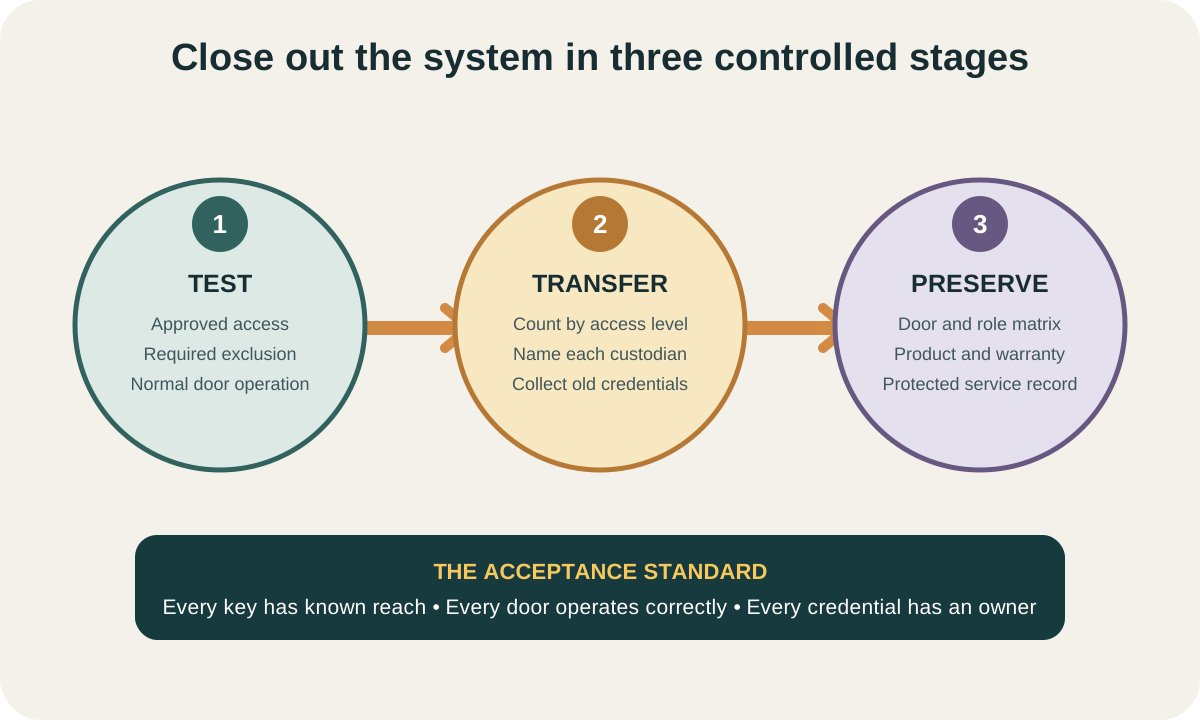
Test every affected opening with the keys it should accept and representative keys it should reject. Operate the door under normal conditions, not only while it is propped open, and confirm the latch retracts, the key turns without excessive force, interior release works, the door closes and latches, and the opening secures again. Record exceptions by door ID before the technician leaves.
Sample every access level, including change keys, department or sub-master keys, site masters, and any authorized overrides. A master working at one office does not prove it works across the approved group, and a change key turning its own cylinder does not prove it is excluded from other areas. The approved matrix becomes the test plan and the signed result becomes the baseline for future service.
Complete a counted handoff showing key identifier, level, quantity, custodian, issue date, and return or replacement process. Store the door schedule, access matrix, approved scope, installed products, warranty, service contacts, and protected system record in controlled locations. The system remains useful only when the next manager can administer it without guessing what the previous manager intended.
When to call Heartland about a master key system in Wichita
Call when a growing business has too many unrelated keys, managers need structured cross-department access, a tenant or department change requires a clean hierarchy, or existing key records no longer match the doors. A consultation is also useful before remodeling or adding a suite, because the hierarchy is easier to plan before hardware has been ordered. For an urgent lost master key or a door that no longer secures, explain the credential level and affected openings when requesting service.
Prepare a door list, rough role map, known keyways or system documents, current key quantities, landlord or corporate contacts, business hours, sensitive areas, and likely expansion. Wide photographs can help identify hardware and door conditions, but keep key cuts, codes, alarm details, bitting, and protected access records out of routine messages. The technician can verify compatibility and condition on site rather than relying on appearance alone.
Heartland can assess the openings, translate roles into a practical hierarchy, identify repair or compatibility issues, and explain an itemized scope. Start with our master key systems service, broader commercial locksmith services, or commercial lock repair when an unreliable opening needs attention before it joins the hierarchy. The aim is a system that makes everyday access simpler while keeping broad authority limited, documented, and ready for the next change.
Frequently asked questions
Questions readers ask
What is the difference between a master key and a change key?
A change key normally operates one cylinder or one intentionally keyed-alike group. A master key operates multiple change-key groups within an approved hierarchy. The exact levels and names vary by system, so the door-and-role matrix should define what each credential is intended to operate.
Should every manager receive a master key?
Not automatically. Issue broad credentials only when the manager's actual duties require that reach, and consider a narrower department key when it meets the role. Every high-level key should have a named custodian, counted issue, return expectation, and lost-key response.
Can existing commercial locks be added to a master key system?
Sometimes. A technician must verify the keyway, cylinder or core format, available combinations, lock function, ownership, and hardware condition. Incompatible or worn components may need cylinder, core, lock, or door work before the opening can participate reliably.
What happens if a business loses a master key?
Report it promptly, identify the credential level, map every opening it may operate, and use the business's authorized response process. The right action may include temporary controls, targeted rekeying, a larger system change, or another documented measure based on risk and the specific hierarchy.
What records should a Wichita business keep after installation?
Keep the approved door schedule and access matrix, key identifiers and quantities, named custodians, issue and return records, installed product information, warranty, test results, service contacts, and outstanding work. Protect technical keying information separately from ordinary operating documents.
The right solution depends on the specific lock, door, vehicle or garage door system. Check the Wichita-area service pages, then call or send the details for an evaluation.