Garage door repair
Warning Signs of a Failing Garage Door Spring
Garage door springs counterbalance most of the door's weight so the system can move in a controlled way. When a spring weakens, loses tension or breaks, the opener may be overloaded and the door may become unsafe to operate. This guide helps Wichita property owners recognize warning signs, stop risky use and gather the information a technician needs.
Stop operating a garage door if it suddenly feels extremely heavy, rises crooked, drops, has a visible spring gap, shows loose cables, produces a loud bang followed by poor movement, or causes the opener to strain. Keep people, pets and vehicles clear. Do not loosen bottom brackets, cut cables or attempt to wind a spring without the correct training and equipment.
Garage door springs counterbalance most of the door's weight so the system can move in a controlled way. When a spring weakens, loses tension or breaks, the opener may be overloaded and the door may become unsafe to operate. This guide helps Wichita property owners recognize warning signs, stop risky use and gather the information a technician needs. Continue with the complete library of garage door repair guides when you want to compare related decisions.
Key takeaways
- The opener guides movement; properly sized springs carry most of the door's effective weight.
- A heavy, crooked or dropping door should not be cycled repeatedly to confirm the problem.
- Springs, cables, drums and bottom brackets work as one counterbalance system.
- Broken-spring symptoms differ between torsion and extension-spring arrangements.
- A complete repair includes identification, compatible parts, balance testing and safety checks.
What a garage door spring actually does
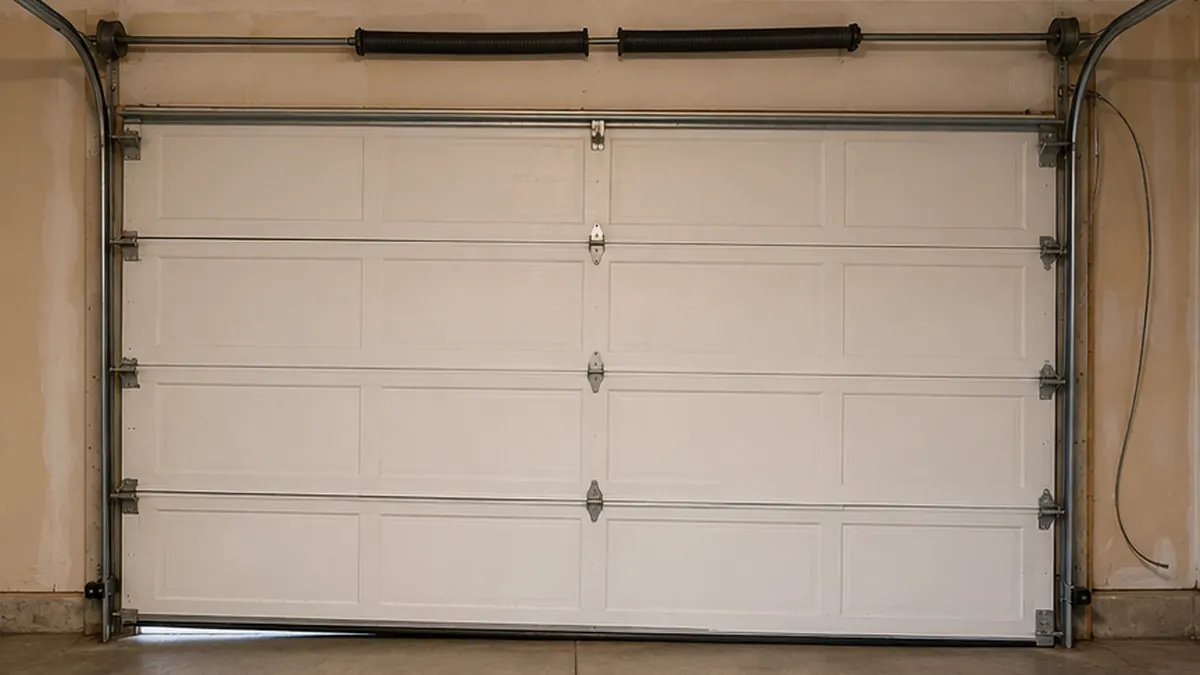
A sectional garage door may weigh far more than it feels during normal operation. Springs store mechanical energy and offset much of that weight. In a torsion system, one or more springs wind around a shaft above the opening and apply torque through drums and cables.
In an extension system, springs stretch along the horizontal tracks and assist movement through pulleys and cables. The details differ, but the purpose is the same: balance the door so it can be moved in a controlled range. If this condition matches your situation, review the service scope for garage door spring repair.
The electric opener is not intended to compensate for a badly unbalanced door. It pulls or pushes the door through a rail while the counterbalance system carries the load.
When spring assistance is lost, the motor, trolley, rail, brackets and door sections can be subjected to forces they were not selected to handle. Increasing force settings or repeatedly pressing the remote does not repair the underlying failure; it can damage more components and create unpredictable movement.
Balance also affects safety features. An opener may reverse or stop because it senses abnormal resistance, but those reactions should not be treated as a diagnostic substitute.
Photo-eye sensors near the floor address obstructions in the opening; they do not make a broken spring or loose cable safe. A professional inspection looks at the door, counterbalance, tracks, rollers, attachment points and controls together before returning the system to normal use.
Torsion springs
Mounted on a shaft above the door. Torque transfers through drums and lift cables on each side.
Extension springs
Stretch alongside the horizontal tracks and use pulley-and-cable arrangements to assist lifting.
Opener
Controls automated travel but should not be expected to lift a door whose counterbalance has failed.
The clearest warning sign: the door becomes unusually heavy
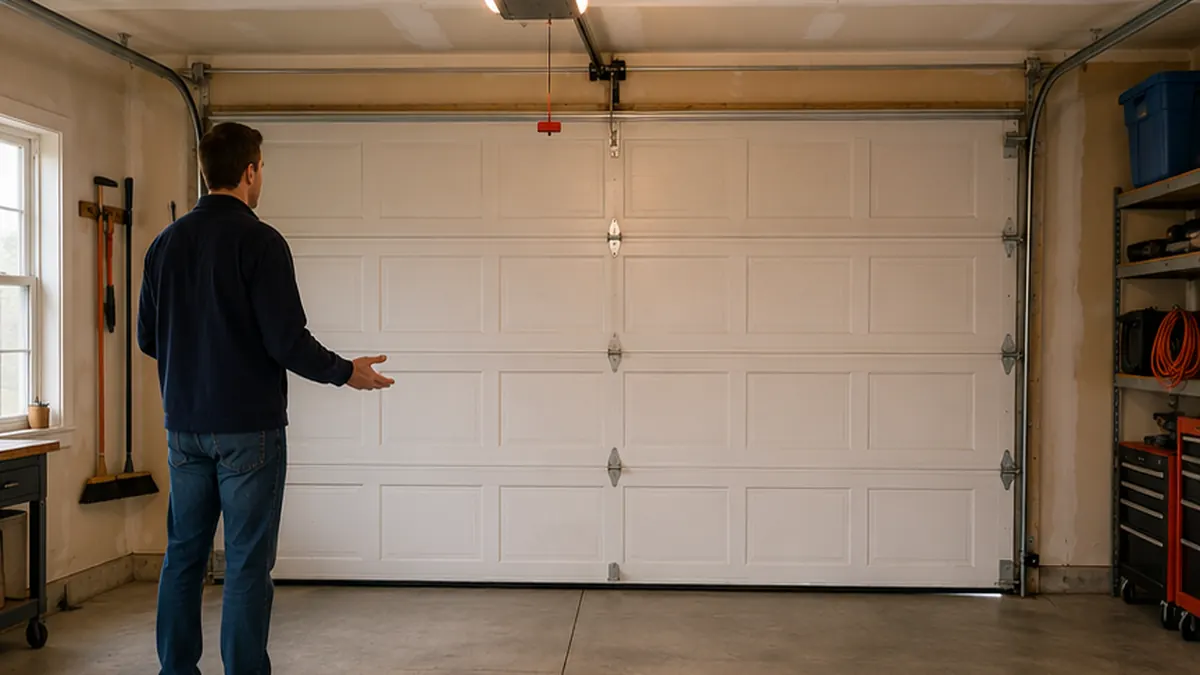
A properly balanced residential door should not feel like its full dead weight during a careful manual balance test performed under appropriate conditions. If a door that previously moved normally becomes extremely difficult to lift, stops after moving only a few inches or falls instead of staying controlled, spring assistance may be missing.
Do not recruit several people to muscle the door upward. The difficulty is information: the system is not carrying the load as designed. If this condition matches your situation, review the service scope for garage door cable repair.
An opener may reveal the same problem indirectly. You may hear the motor run while the door barely moves, see the rail flex, watch the trolley struggle or notice that the opener reverses under load. Disconnecting the opener with the emergency release is not automatically safe.
Federal safety language for residential operators warns that weak or broken springs can allow an open door to fall rapidly. If the door is raised, unstable or visibly damaged, keep clear and leave the system in place for a qualified assessment.
Weight symptoms can also result from multiple causes, including binding tracks, damaged rollers, a door section problem or incorrect spring sizing. That is why replacement should not be based only on a guess that a spring 'looks old.' The technician should identify how the door moves, whether both sides lift evenly, whether cables remain seated and whether the spring system matches the door's height and weight.
For independent guidance, review Door & Access Systems Manufacturers Association's Garage door and opener safety tips (opens in a new tab).
Loud bang, visible gap and sudden change in operation
A torsion spring can release stored energy with a sharp bang when it breaks. Homeowners sometimes mistake the sound for something striking the house or garage. The next attempt to open the door may move only a short distance because the opener now faces a much heavier load.
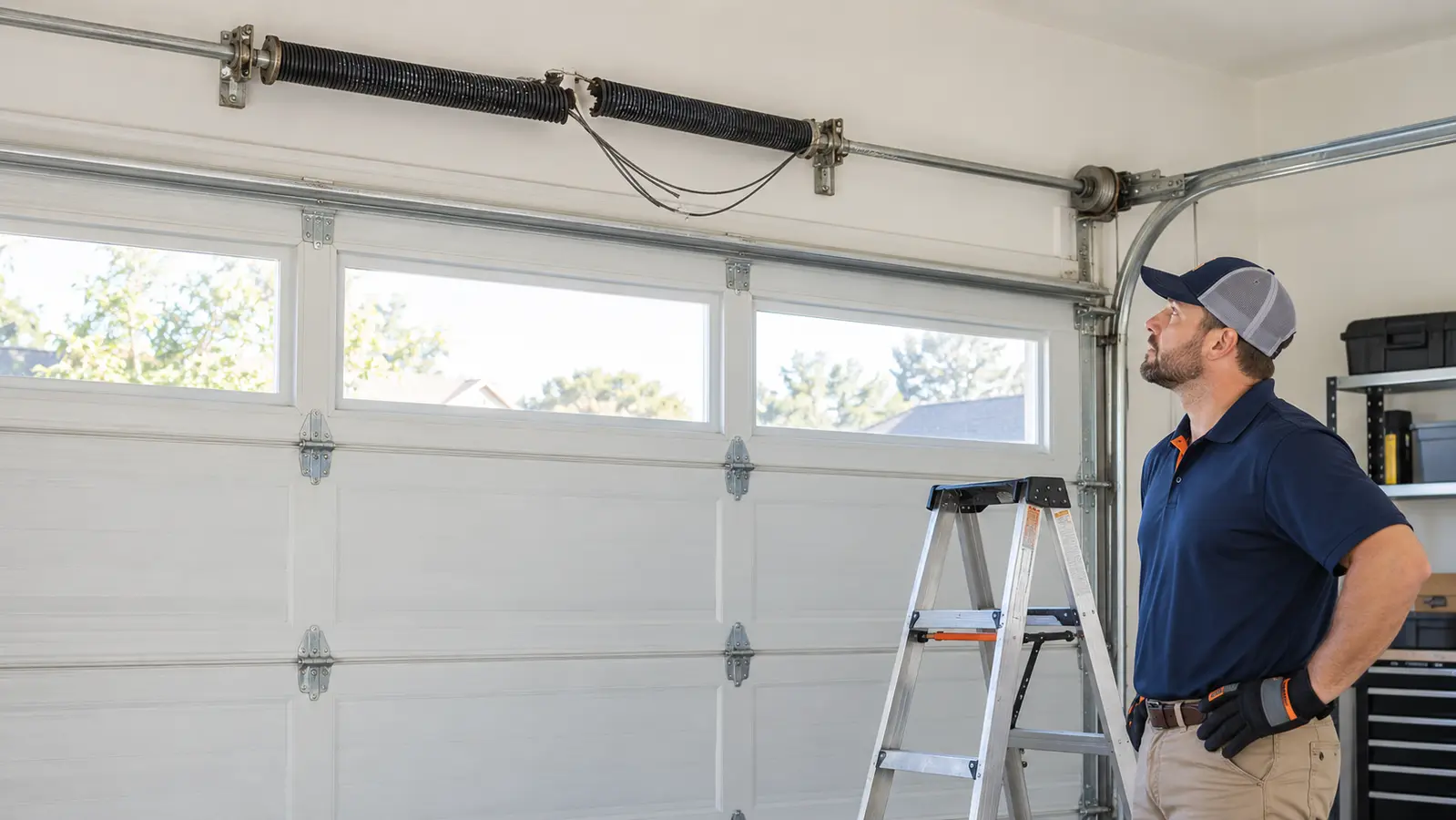
On many torsion springs, a break creates a visible separation in the coil along the shaft. Do not touch the spring or assume the other spring, if present, makes continued operation acceptable. If this condition matches your situation, review the service scope for garage door repair.
Not every failure is dramatic. A spring may weaken gradually, lose effective tension or corrode until performance changes. The door may begin closing faster, feel less controlled or stop holding a balanced position.
The opener may sound louder because it is compensating for increased load. Changes that develop slowly are easy to normalize, but they still matter. Compare present behavior with how the door worked when it was functioning correctly.
Extension-spring failures may leave a spring hanging or a cable displaced along the side of the opening. Older arrangements without containment cables can create additional hazards if a spring breaks.
Do not stand in line with a stretched spring or try to reconnect a loose component. Keep the garage clear until the system type and condition are confirmed.
Crooked travel, loose cables and one-sided lifting
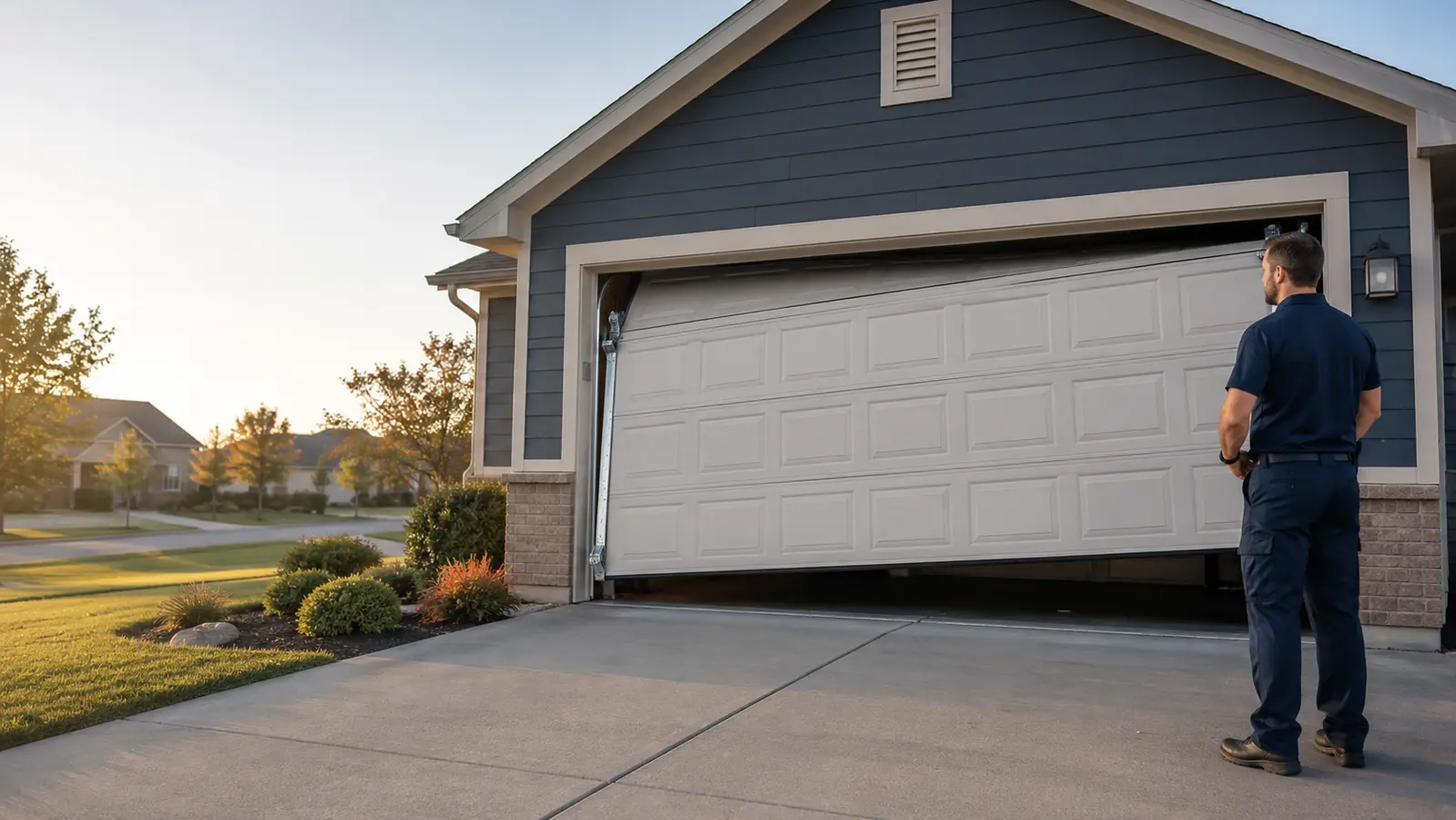
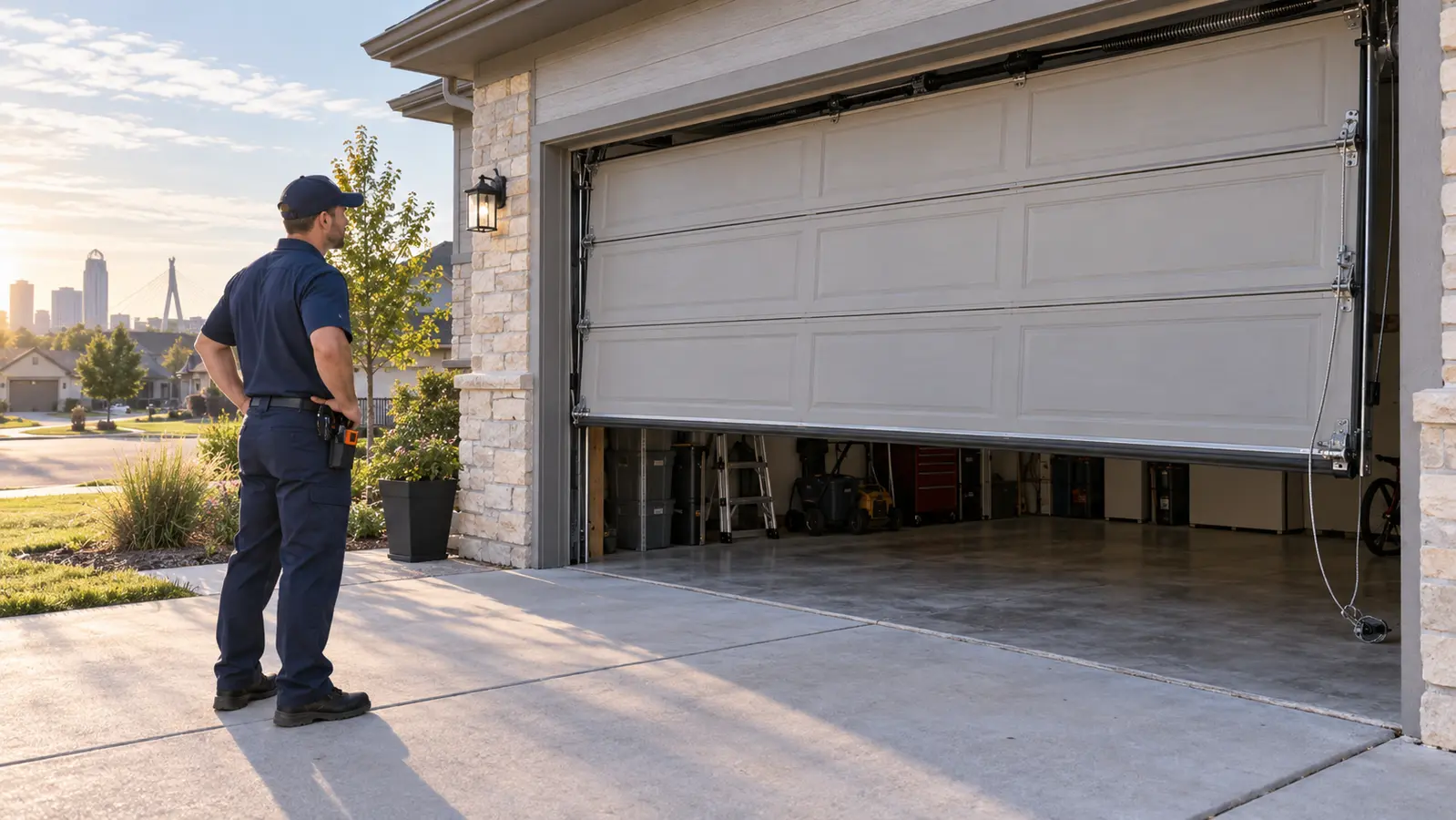
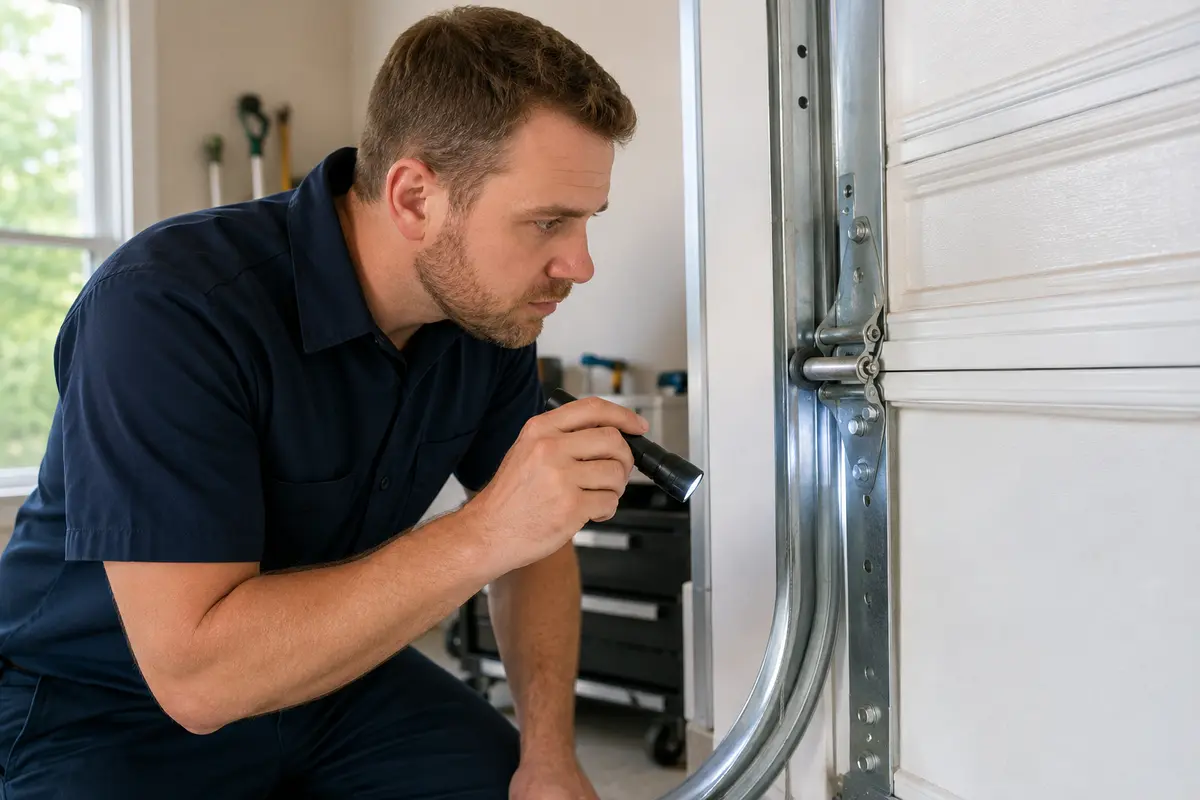
A sectional door should rise and lower evenly within its tracks. If one bottom corner climbs while the other remains low, or the door becomes visibly diagonal, stop movement.
One side may not be carrying the same load because of a cable, drum, spring or track problem. Continued operation can pull rollers from the track, crease sections and place the door in a position where it can shift unexpectedly.
Lift cables run from the bottom portion of the door to drums or pulley arrangements, depending on the system. They are part of the counterbalance, not ordinary ropes. A cable that looks slack, frayed, off a drum or wrapped unevenly is not something to cut or pull.
Bottom fixtures may remain connected to high spring tension even when the door will not move. Loosening those fasteners can release force suddenly.
Track defects can produce similar visual symptoms. Impact from a vehicle, loose jamb brackets, a bent vertical track or failed roller can make one side bind.
A complete assessment separates the initiating failure from secondary damage. Replacing a spring without correcting a bent track or cable problem may leave the door unable to travel safely; correcting only the track while the spring is broken leaves the door unbalanced.
| What you observe | Possible system area | Recommended response | Do not |
|---|---|---|---|
| Door rises crooked | Cable, drum, roller, track or spring | Stop and keep the opening clear | Force the high or low side |
| Cable is loose or frayed | Lift system | Avoid contact and request inspection | Cut, unwind or re-seat it |
| Visible gap in torsion spring | Broken spring | Leave the door closed when possible | Run the opener repeatedly |
| Opener hums but door barely moves | Counterbalance or opener load | Stop before the motor overheats | Increase force settings |
| Door drops or closes rapidly | Lost balance or control | Keep everyone away | Stand beneath or try to catch it |
Noisy operation: which sounds matter
Garage doors make mechanical noise, but a new or sharply different sound deserves attention. A single loud bang followed by heavy operation strongly suggests an abrupt counterbalance event. Popping can occur as coils or components move under load, while scraping may indicate a cable, roller or track issue.
Grinding from the opener can point to drive wear or excessive load. Sound alone cannot identify the failed part, but timing and context help narrow the inspection.
Record when the sound occurs: at the start of opening, halfway through travel, near the floor or during closing. Note whether the door shakes, hesitates or changes speed at the same point. Observe from a safe distance without placing yourself under the door or between moving parts.
A short video can be useful only if it can be captured without cycling an unsafe system. Do not operate the door solely to produce evidence for a service request.
Routine squeaks are not an invitation to spray every visible component with a general-purpose product. Different rollers, bearings, hinges, tracks and spring systems have different maintenance needs, and some surfaces should remain clean rather than oily.
Use manufacturer guidance for normal maintenance. When noise comes with weight, crooked travel, loose cable or visible damage, treat it as a repair issue instead of a lubrication task.
- Loud bang followed by heavy movement
- New popping or snapping under load
- Scraping that occurs at the same travel point
- Grinding or straining from the opener
- Rapid rattling from loose track or support hardware
- Noise combined with shaking, hesitation or speed changes
Why repeated opener use can make the damage worse
When a remote fails to produce normal movement, many people press it several more times. That instinct can be costly with a broken spring.
The opener may continue trying to lift a load it cannot manage, overheating the motor, damaging internal gears, bending the rail or pulling on the top section and opener reinforcement. A door that moves a few inches and stops is not asking for another attempt; it is signaling abnormal resistance or load.
Do not respond by increasing travel or force controls. Those settings influence how the operator behaves, but they do not restore balance. Excessive force can also interfere with normal obstruction response.
Likewise, replacing an opener because it appears weak may leave the actual door problem untouched. The physical door should be able to move appropriately before an operator is expected to automate it.
If a vehicle is trapped, tell the service provider rather than improvising. The technician can evaluate the safest way to manage the door based on its position, spring arrangement, cable condition and available space.
A closed door with a broken spring is inconvenient, but an unsupported raised or partially raised door can be more dangerous. Protect people first and schedule around the equipment rather than forcing the equipment around the schedule.
For independent guidance, review Door & Access Systems Manufacturers Association's Garage door technical data sheets (opens in a new tab).
How a technician evaluates the counterbalance system
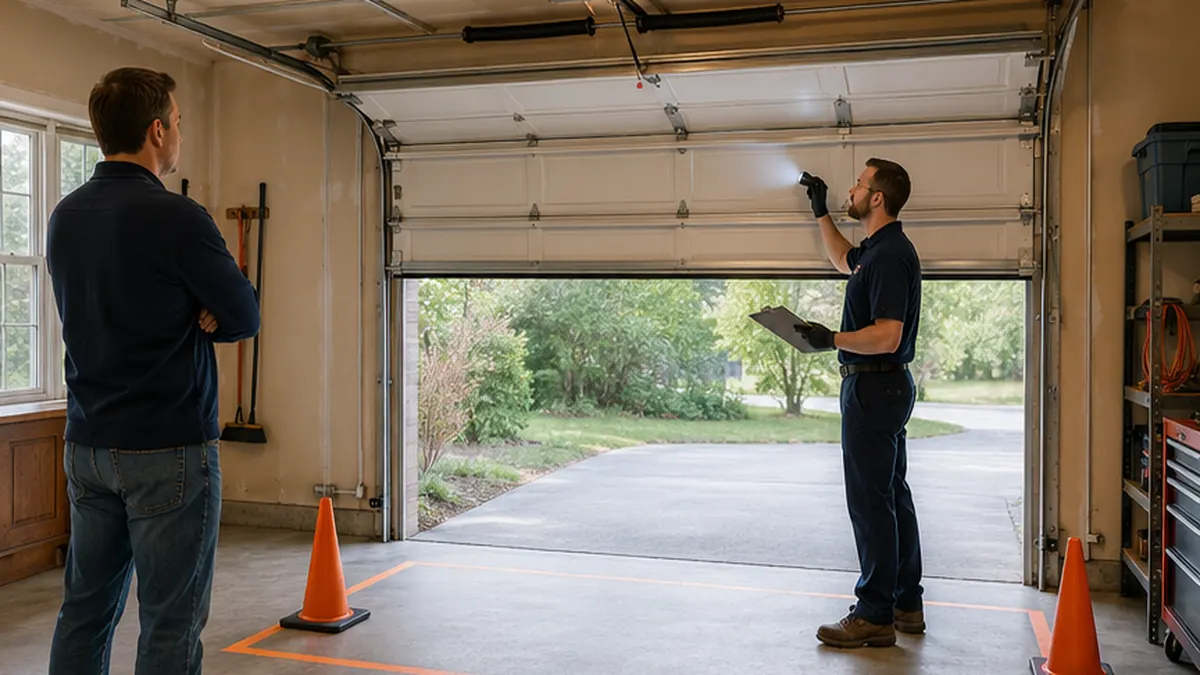
A useful service visit begins with identification. The technician notes the door type, width, height, construction, spring arrangement, drum or pulley configuration and visible condition.
Door weight and system specifications affect spring selection; appearance alone is not enough. Existing springs may have been changed previously, and an installed part is not proof that it was correctly sized.
The inspection should include cables, drums, bearings, shaft, end and center supports, bottom fixtures, tracks, rollers, hinges and opener attachment. Damage can travel through the system.
A cable may jump because a door section was struck; a roller may leave the track after one side lost tension; an opener bracket may loosen because the door became heavy. Identifying the sequence prevents a narrow repair from overlooking the reason it occurred.
After compatible work is completed, the door should be tested for controlled manual travel and balance before the opener is relied upon. Cable seating, track movement and section behavior should be observed through the range.
The operator's travel, force behavior and reversal functions can then be verified as applicable. The final test is not simply whether the remote makes the door move once; it is whether the complete system operates consistently.
Identify the door
Size, construction, height, weight and lift arrangement influence the correct counterbalance.
Check connected parts
Cables, drums, bearings, tracks, rollers, sections and operator attachments can share the damage.
Balance before automation
Controlled manual behavior should be established before opener travel and safety functions are tested.
One spring or two: why system design matters
Many residential torsion systems use one spring, while wider or heavier doors may use two. When one spring in a paired arrangement breaks, the remaining spring may still provide some assistance, which can make the door appear partly functional.
That does not mean normal operation should continue. The remaining spring is carrying a different load, the door is no longer balanced as designed and the opener may still be overloaded.
Whether both springs should be replaced is a system-specific decision. Age, cycle history, condition, matching characteristics and manufacturer or technician guidance all matter.
Replacing only one may leave a significantly older companion spring in service; replacing both without verifying sizing may repeat an existing mismatch. Ask how the proposed springs are selected for the actual door and how balance will be confirmed after installation.
Spring cycle ratings are estimates based on operating cycles, not calendar guarantees. One full opening and closing is generally treated as a cycle, so a household using the garage as its main entrance can accumulate cycles faster than one that operates the door twice a day.
Corrosion, environment, door changes and incorrect balance can also influence service life. Avoid promises that a spring will fail on a predictable date.
| Factor | Why it matters | Information to provide |
|---|---|---|
| Door dimensions | Height and width affect travel and load | Approximate opening size |
| Door construction | Steel, wood, insulation and windows change weight | Material and visible labels |
| Spring arrangement | Single, paired, torsion and extension systems differ | Wide photo above and beside the door |
| Use pattern | More daily cycles can accelerate wear | Typical openings per day |
| Prior modifications | Panels, insulation or hardware may change balance | Recent repairs or upgrades |
What to do while waiting for service
When a spring or cable problem is suspected, stop using wall controls and remotes. Tell household members not to operate the door, and keep children and pets away from the garage opening. If the door is closed, leave it closed unless a qualified professional directs otherwise.
If it is open or partially open, do not walk, park or work beneath it. Use another entrance to the property if one is available and secure the interior access door.
Do not touch a hanging cable, broken spring, bottom bracket or shaft component. Avoid attempting to clamp the door, stack objects beneath it or support it with improvised lumber.
These measures may shift while the door is loaded. If the door has left the track or is leaning, expand the clear zone because movement may not be limited to straight up and down.
Gather information without cycling the system. Take wide photos of the complete interior door, the area above the opening, both vertical tracks and the opener. Add close photos of any visible spring gap, loose cable, bent track or damaged section from a safe position.
Share whether the door is open or closed, whether a vehicle is trapped, what sound occurred and what happened on the last successful cycle. This helps prepare the visit without creating another hazard.
- Disable routine use of remotes and wall controls.
- Keep people, pets and vehicles out of the door's travel area.
- Leave a closed door closed when possible.
- Do not stand beneath a raised or partially raised door.
- Do not cut cables or loosen bottom fixtures.
- Photograph visible conditions only from a safe position.
- Report the door position and whether access is blocked.
- Use a separate property entrance while waiting for service.
Preventive habits that support safer operation
Preventive attention cannot guarantee that a spring will never break, but it can reveal changes before the system becomes unusable. Watch the door during ordinary cycles rather than walking away immediately after pressing the remote.
Notice changes in speed, symmetry, sound and vibration. Keep the track area clear of stored items, and do not hang objects from the door, tracks or spring supports.
Test the operator's safety features according to the manufacturer's instructions and schedule. Photo eyes should remain aligned, clean and unobstructed, but remember that they are only one layer of the system.
The door must also remain properly balanced and mechanically sound. Manufacturer instructions and federal safety language consistently emphasize qualified service for spring assemblies, cables and related hardware.
After impact, storms, remodeling or a change to door sections, request evaluation if operation changes. Adding material to a door can alter its weight. Moving tracks or opener supports for ceiling work can disturb geometry.
Kansas temperature swings and wind exposure can reveal loose supports and seal resistance. Early assessment is usually simpler than waiting for the opener to fail while compensating for a heavy or binding door.
Frequently asked questions
Questions readers ask
Can I open a garage door with a broken spring?
A broken spring can make the door extremely heavy and unstable. Do not force it with the opener or lift it with people beneath it. Tell the service provider the door position and whether a vehicle is trapped so the condition can be managed safely.
What does a broken torsion spring look like?
A common sign is a visible gap in the spring coil above the door, often accompanied by a loud bang and a door that moves only a short distance. Do not touch the spring or shaft to confirm it.
Why does my garage door open a few inches and stop?
The opener may be encountering abnormal weight or resistance caused by a broken spring, binding track, cable issue or another mechanical fault. Stop repeated attempts and have the complete system evaluated.
Should both garage door springs be replaced?
It depends on the paired system, spring age, condition, matching characteristics and door requirements. Ask how the proposed parts are sized and how balance will be verified.
Can I replace a garage door spring myself?
Spring systems, cables and bottom brackets can contain dangerous stored energy. This is not casual DIY work. Qualified service with proper tools and procedures is the safer choice.
Does the garage door opener lift the weight of the door?
The opener moves the system, but properly selected springs counterbalance most of the door's effective weight. An opener should not be used to compensate for failed balance.
Why are the garage door cables loose?
Loose cables can result from spring failure, a cable leaving the drum, uneven door movement or track and section problems. Do not cut or attempt to re-seat them.
Is a loud bang always a broken spring?
No, but a loud bang followed by heavy, crooked or failed door movement is a strong reason to stop operation and inspect the counterbalance system.
What pictures should I send for a spring repair request?
Send a wide view of the inside door, the spring and shaft area above it, both side tracks, cables, opener and any visible damage. Take photos without moving the door or entering an unsafe area.
Does Heartland repair garage door springs around Wichita?
Heartland handles garage door repair requests in Wichita and surrounding areas, subject to location, door type and current availability. Call with the door position and visible symptoms.
The right solution depends on the specific lock, door, vehicle or garage door system. Check the Wichita-area service pages, then call or send the details for an evaluation.