Automotive locksmith
Car Key Programming: What Wichita Drivers Should Know
Modern car keys are often several systems in one. A replacement may need the correct mechanical cut, compatible transponder authorization, remote functions and proximity behavior. This guide explains the process, what information Wichita drivers should gather and why a key that looks identical may still be wrong for the vehicle.
Car key programming authorizes a compatible transponder, remote or proximity credential to work with a specific vehicle. Successful replacement may also require cutting a mechanical blade and testing emergency entry, ignition or push-button start, lock and unlock, trunk and proximity functions. Exact requirements vary by make, model, year, trim and key system.
Modern car keys are often several systems in one. A replacement may need the correct mechanical cut, compatible transponder authorization, remote functions and proximity behavior. This guide explains the process, what information Wichita drivers should gather and why a key that looks identical may still be wrong for the vehicle. Continue with the complete library of automotive locksmith guides when you want to compare related decisions.
Key takeaways
- Housing shape does not prove compatibility; chip, frequency, part number and vehicle configuration matter.
- The VIN helps identify the vehicle, but it does not guarantee that every lock and module remains factory-original.
- Having one working key can change the available programming process for some vehicles.
- Ownership or authorized-use verification is a normal part of responsible vehicle key service.
- A replacement is not complete until every supported mechanical and electronic function is tested.
Why modern vehicle keys are more than cut metal
Older vehicle keys could be understood mainly by the shape of the blade. Many modern keys add an electronic transponder that must be recognized before the engine is authorized to start.
A remote-head key may combine the blade, transponder and lock buttons in one shell. A proximity fob may let the driver unlock and start the vehicle while the credential remains in a pocket, yet still contain a small emergency blade for mechanical entry when the battery or electronics are unavailable. If this condition matches your situation, review the service scope for car key programming.
These layers can fail independently. A blade may open the door but a mismatched chip may not start the engine. A properly programmed transponder may start the vehicle while worn buttons fail to lock or unlock.
A proximity fob may be recognized intermittently because of its battery, internal damage, vehicle battery condition or receiver-side issues. Describing the exact symptom is more useful than saying only that the key 'doesn't work.'
Vehicle security systems are not standardized into one universal procedure. Manufacturers, model generations, trim levels, regions and production dates can use different chips, frequencies and programming methods.
Some jobs can be completed through supported onboard steps when a working credential is present; others require diagnostic equipment, security access or additional procedures. A responsible provider checks the exact vehicle before promising compatibility.
Mechanical blade
Physically operates a door, trunk or ignition cylinder when the vehicle uses that function.
Transponder
Communicates an authorized identity used by the immobilizer or start system.
Remote or proximity
Controls buttons or passive-entry features using compatible radio electronics.
Key types Wichita drivers commonly encounter
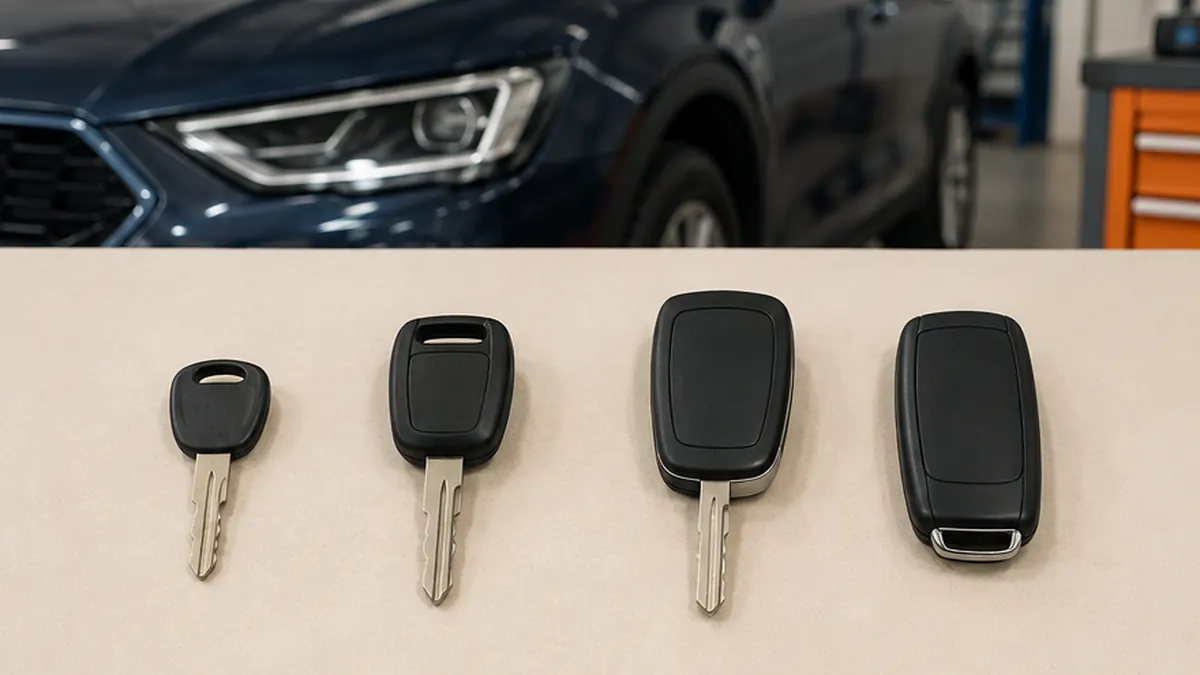
A basic transponder key looks similar to a traditional key but contains a chip in the head. A remote-head key places buttons and a transponder in the same body. A flip key folds the blade into the remote housing.
A proximity or smart key supports passive entry and push-button start on compatible vehicles. Some vehicles use a separate remote and key, while others use integrated credentials. Each format can have multiple electronic variants that are not visually obvious. If this condition matches your situation, review the service scope for car key replacement.
The emergency blade in a proximity fob deserves attention. Drivers may never use it until the vehicle or fob battery is depleted, and then discover that the blade was never cut, does not match the door or is missing from an aftermarket shell.
A complete key replacement should include the mechanical backup when the original design provides one. Test where and how it is used before an urgent situation.
Aftermarket and original-equipment keys can both be viable when the exact part is compatible and quality is appropriate, but broad labels such as 'fits Toyota' or 'works with Ford' are not enough. The same body style may span different frequencies, chips or button arrangements. Ask how compatibility was confirmed and which functions are expected to work rather than relying on a marketplace title or photograph.
For independent guidance, review National Highway Traffic Safety Administration's Official VIN decoder (opens in a new tab).
| Key format | Mechanical work | Electronic work | Common test points |
|---|---|---|---|
| Transponder key | Blade cutting | Immobilizer authorization | Door, ignition and start |
| Remote-head key | Blade cutting | Transponder and remote functions | Start, lock, unlock and trunk |
| Flip key | Blade cutting and hinge check | Chip and remote programming | Blade deployment, start and buttons |
| Proximity fob | Emergency blade cutting | Smart-key registration | Passive entry, push start and buttons |
| Separate key and remote | Key cutting | Transponder and remote may be separate | Start plus every remote button |
Why two identical-looking fobs may not be interchangeable
Automotive key housings are designed for product families, so two units can share the same shape while using different electronics. Frequency determines the radio band used by remote or proximity functions. Transponder family affects immobilizer communication.
Part numbers and board identifiers distinguish revisions. Button count and icon layout may reflect features such as a trunk, hatch, remote start or power doors. A shell photograph cannot reveal every one of these details. If this condition matches your situation, review the service scope for key fob replacement.
Production changes create another complication. A model year can include different systems depending on build date, trim or market. Vehicles that look the same from outside may use turn-key ignition in one trim and push-button start in another.
Some replacement catalogs divide compatibility by VIN range or option code. Accurate make, model and year are the beginning of identification, not the entire process.
Used fobs can present additional limitations. Some credentials can be prepared for reuse under supported conditions; others remain locked, retain prior data or are unsuitable for reliable service. A new shell around used electronics does not make the board new.
Before buying a low-cost online fob, confirm whether the exact unit can be used for the vehicle and whether the provider is willing to program customer-supplied parts. Otherwise, the apparent savings may become the cost of a second correct key.
The role of the VIN—and its limitations
The 17-character vehicle identification number is a standardized identifier that helps describe the manufacturer and vehicle configuration. NHTSA identifies the VIN as a core vehicle identifier and provides a public decoder for basic manufacturer data. For service, the VIN can help narrow make, model, model year and other attributes, and it may support key-code or parts research through authorized systems when available.
You can commonly find the VIN at the lower driver's side of the windshield, on a label inside the driver's doorjamb and on registration or insurance documents. Read all 17 characters carefully; confusing a zero with the letter O or transposing characters can point to the wrong vehicle. A photograph can reduce transcription errors, but protect personal documents and share only what is necessary with the service provider.
The VIN does not prove that every lock cylinder, control module or key system remains original. Vehicles may have replacement doors, ignition cylinders, steering columns, modules or imported components after theft, collision or repair.
A code associated with factory configuration may not operate a cylinder changed later. This is why physical and electronic verification remains important even when the VIN is correct.
- Copy all 17 VIN characters without spaces or substitutions.
- Confirm whether the vehicle uses a turn key, slot key or push-button start.
- Report the exact trim when known and any remote-start or power-door features.
- Mention replaced ignitions, doors, columns or security modules.
- State whether the vehicle is a U.S.-market or imported configuration when relevant.
- Keep registration and identification available for authorization checks.
Working key versus all-keys-lost service
The presence of one verified working key can substantially change the job. It may provide a pattern to compare, confirm the current mechanical locks and allow supported addition procedures for certain vehicles.
It also gives the technician a baseline for testing the vehicle. A duplicate made while a good key remains available is usually easier to plan than an all-keys-lost request made after the last credential disappears.
All-keys-lost service requires establishing mechanical and electronic access without a working reference. Depending on the vehicle, the process may involve entry, code or key-data research, blade generation, immobilizer procedures and removal of missing credentials from active memory.
Some systems require longer security waits, specific equipment or dealer involvement. Exact availability should be checked before dispatch, particularly for unusual, luxury, European, commercial or very new vehicles.
Tell the provider whether the key is lost, locked inside, broken, water-damaged or simply not recognized. A key locked in the trunk calls for access rather than replacement if it remains usable. A broken shell may allow electronics to be transferred when appropriate.
A no-start condition may originate in the vehicle, not the key. Accurate symptoms help avoid replacing a credential that is not the cause.
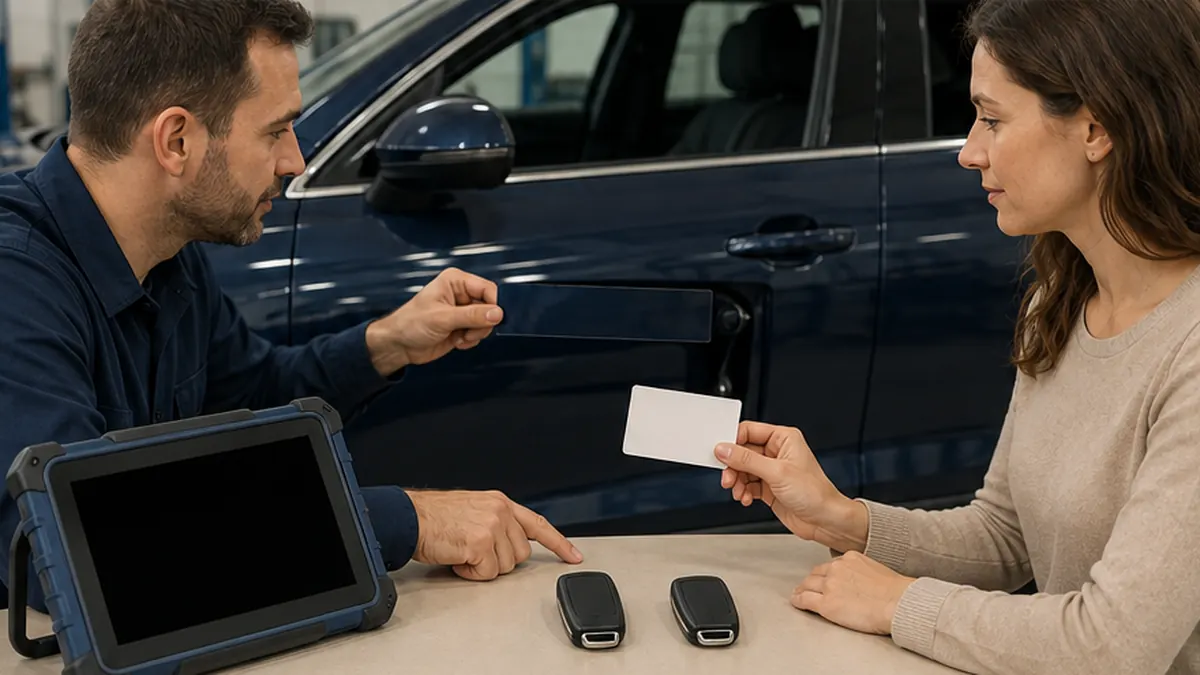
| Situation | Likely focus | Information that helps | Potential complication |
|---|---|---|---|
| Working key remains | Duplicate or spare addition | Bring the known-good key | Worn original may be a poor cutting reference |
| Key locked inside | Authorized vehicle entry | Exact location of key if known | Dead vehicle battery or trunk isolation |
| Broken key | Extraction, decoding or replacement | Keep every broken piece | Cylinder damage or missing chip |
| All keys lost | Create and authorize replacement | VIN, ownership and start type | Security access and vehicle-specific limits |
| Key present but no start | Diagnosis before replacement | Dashboard messages and recent events | Vehicle battery, antenna or immobilizer fault |
What programming does—and what it does not do
Programming is the process of registering or synchronizing compatible electronic credentials with the vehicle's security or convenience systems. A transponder procedure addresses engine authorization. Remote programming addresses button functions.
Proximity registration addresses passive detection and push-button start. Some vehicles combine these steps; others treat them separately. The exact tool screens and sequence depend on the vehicle and should not be generalized into one universal recipe.
Programming does not cut the mechanical blade, repair worn buttons, restore a damaged vehicle antenna or charge a weak vehicle battery. It also cannot make an incompatible part become compatible. If a diagnostic tool reports success but the key does not perform expected functions, the provider should verify part identity, mechanical work, battery condition and vehicle-side operation rather than repeating the same procedure indefinitely.
Some procedures can erase or replace credential lists, which is why every key the owner wants to retain may need to be present. Ask whether missing keys will remain authorized and whether existing keys must be reintroduced.
This is particularly important after theft or an unaccounted-for fob. A security-focused replacement should address who can still start or unlock the vehicle, not only add one more credential.
For independent guidance, review National Highway Traffic Safety Administration's Vehicle and equipment recall lookup (opens in a new tab).
Transponder
Lets a compatible chip satisfy the vehicle's immobilizer or start authorization.
Remote buttons
Pairs supported lock, unlock, panic, trunk or remote-start commands where applicable.
Proximity
Registers a compatible smart credential for passive entry and push-button start.
Ownership verification and responsible key service
A vehicle key is an access credential, so responsible service requires reasonable proof that the requester owns the vehicle or is authorized to use it. Common documents include government-issued identification and current registration, title, insurance information or fleet authorization that connects the requester to the VIN. The exact documentation can vary by circumstances, such as a newly purchased vehicle, rental, company fleet, dealership inventory or estate.
If your documents are locked inside the vehicle, explain that before service. The provider may use available information and complete verification as soon as access is restored.
Do not expect a technician to create a key for an unattended vehicle based only on a phone request from someone who is not present and cannot establish authority. These safeguards protect vehicle owners and legitimate operators.
Choose a safe service location. A private driveway or legal parking area is generally more workable than an active traffic lane, restricted garage or unsafe roadside shoulder.
Share parking-garage height, security-gate rules and property-management requirements. If the vehicle creates a traffic hazard or anyone is in danger, contact the appropriate emergency or roadside authority before treating the situation as routine key service.
Testing a replacement key completely
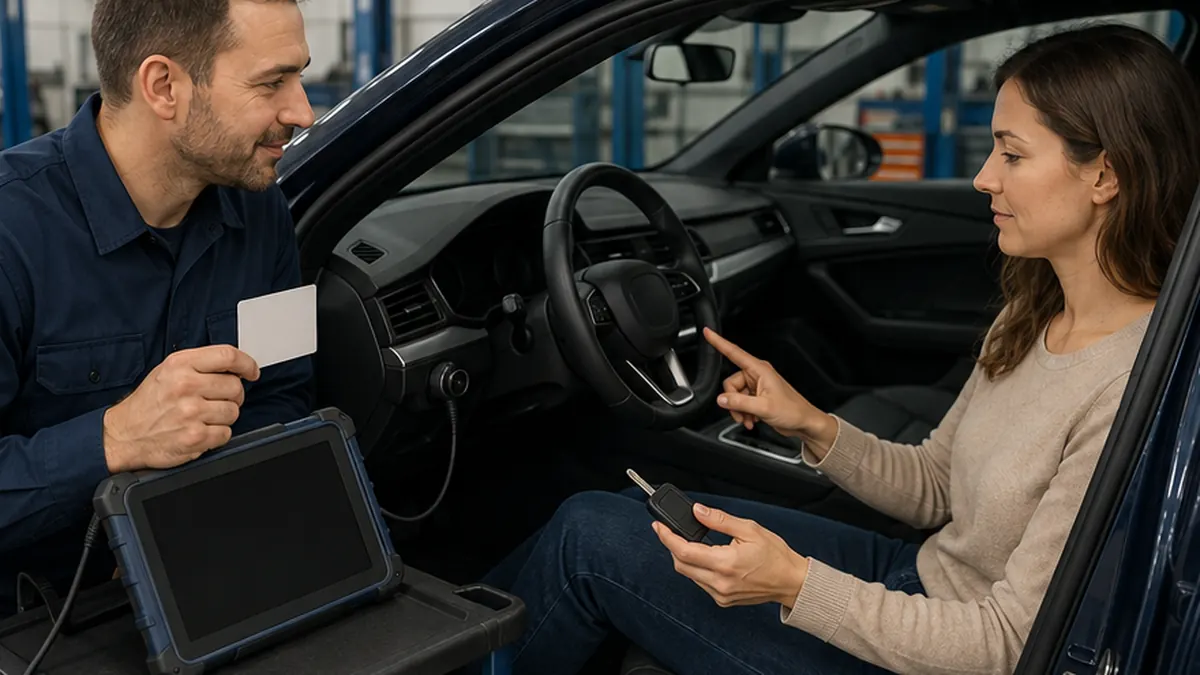
A replacement key should be tested against every supported function, not declared finished when the engine starts once. For a blade key, test door entry and ignition rotation without forcing either cylinder.
For a remote, test lock, unlock, panic, trunk or hatch and remote start if the vehicle supports them. For a proximity fob, test passive entry at relevant doors, push-button start and any required backup-start position.
Test the emergency blade in the mechanical door cylinder. Many drivers discover a problem only after a battery failure because the blade was never cut or the cylinder has not been used in years.
The blade should operate the intended lock without excessive force. If the cylinder is seized or does not match, that is a separate issue worth documenting even when electronic entry works normally.
Compare the new credential with any working original. Range should be reasonably consistent, buttons should correspond to the correct features and the vehicle should not display persistent key or immobilizer warnings.
Keep the invoice and any part identifiers provided. If a customer-supplied key offers only partial functionality, document which functions were expected and which were not supported rather than leaving ambiguity.
- Mechanical door entry
- Ignition rotation or push-button start
- Lock and unlock buttons
- Trunk, hatch or power-door controls
- Panic function
- Remote start when equipped
- Passive entry at supported doors
- Emergency blade and backup-start method
Common reasons a key still does not work
A failed result does not always mean the programming tool or technician made an error. The part may use the wrong frequency or chip, the fob battery may be weak, the vehicle battery may be too low for stable programming, the key antenna may be damaged or the vehicle's receiver may have a fault.
Previously replaced modules can also change the expected procedure. Diagnosis should separate key-side and vehicle-side conditions.
Mechanical failures have their own causes. A blade cut from an incorrect code, duplicated from a badly worn key or matched to factory records after a cylinder replacement may not operate smoothly. Never force a newly cut blade.
Compare it with existing keys and inspect the cylinder history. If one door works but the ignition does not, the vehicle may contain mismatched cylinders from prior repairs.
Intermittent recognition can be especially misleading. Radio interference, a depleted fob battery, a weak 12-volt vehicle battery, water damage and internal cracked solder joints can produce inconsistent behavior.
Record where the fob is held, which doors respond, whether backup-start works and when the symptom began. Replacing parts without that pattern can lead to an expensive sequence of guesses.
| Symptom | Possible key-side issue | Possible vehicle-side issue | Useful check |
|---|---|---|---|
| Blade works, engine will not start | Chip mismatch or authorization | Immobilizer or antenna fault | Observe security warning and test known-good key |
| Engine starts, buttons fail | Remote not paired, wrong frequency or bad buttons | Receiver or fuse issue | Compare original remote behavior |
| Short remote range | Weak battery or damaged board | Interference or receiver issue | Install correct fresh battery and compare locations |
| Proximity is intermittent | Fob battery or internal damage | Vehicle battery or antenna issue | Test backup-start position |
| New blade binds | Incorrect or rough cut | Changed or worn cylinder | Stop forcing and compare other locks |
How to prepare for mobile automotive locksmith service
Before calling, gather the make, model, model year, trim and VIN. Identify whether the vehicle uses a traditional ignition, slot, twist knob or push-button start.
State whether any working key remains and describe the missing or failed key: separate remote, transponder key, flip key or proximity fob. Mention unusual features such as remote start, power sliding doors or a powered hatch because button layout and electronic requirements may differ.
Describe the vehicle's location and access conditions. Include parking level, garage clearance, gate or property rules, roadside safety and whether the battery is depleted.
If all keys are lost, have identification and ownership documents ready. If the key broke, retain every piece, including the plastic head, because the transponder may be separate from the blade.
Ask what the proposed service includes: entry, blade cutting, programming, emergency blade, removal of missing credentials and testing. Confirm whether the quoted part is original-equipment or aftermarket when that matters to you, and ask about customer-supplied-fob policies before purchasing one. Clear scope is more useful than a low headline price that excludes the blade or programming step needed to make the key usable.
Building a better spare-key plan
The best time to create a spare is while a fully working key remains. A verified original makes it easier to compare part identifiers, blade operation and vehicle behavior.
Store the spare in a secure location that is accessible to an authorized person but not inside the vehicle. A spare locked in the same car does not solve a lockout, and a spare hidden on the vehicle can create unnecessary access risk.
Test the spare periodically. Batteries discharge, buttons deteriorate and emergency blades can remain untested for years.
Confirm start, entry and supported remote functions, then replace batteries according to the key and manufacturer guidance. Do not store credentials directly beside equipment that may cause interference, and avoid leaving them in extreme heat or moisture.
For households and fleets, document which key belongs to which vehicle without publishing sensitive details. Remove or secure credentials when vehicles are sold, employees leave or access changes.
If a fob is stolen, ask whether it can be removed from the active key list. A spare-key strategy is not only about avoiding inconvenience; it is an ongoing access-control practice for the vehicle.
Frequently asked questions
Questions readers ask
What is car key programming?
It is the vehicle-specific process of authorizing a compatible transponder, remote or proximity credential. Mechanical blade cutting is a separate but often related part of replacement.
Can a locksmith program a key when all keys are lost?
For many supported vehicles, yes, after ownership verification. Availability depends on make, model, year, system, equipment and service conditions.
Does a replacement key always need programming?
Traditional non-transponder keys may not, but most modern transponder, remote-head and proximity keys require electronic authorization for some or all functions.
Can I buy a fob online and have it programmed?
Possibly, if the exact part, frequency, chip and vehicle configuration are compatible and the provider accepts customer-supplied parts. Similar appearance is not enough.
Why does my key unlock the door but not start the car?
The mechanical blade can match while the transponder is missing, incompatible or unauthorized. Vehicle-side immobilizer or antenna faults can produce a similar symptom.
Do I need the VIN for car key replacement?
The VIN is very helpful for identifying the vehicle and researching supported parts or key information. It does not guarantee the locks and modules remain factory-original.
What proof of ownership should I have?
Be ready with government-issued identification and current registration, title, insurance or fleet authorization connecting you to the vehicle. Requirements vary by situation.
Will programming a new key erase my old keys?
Some procedures add credentials while others rewrite the active list. Ask whether every retained key must be present and whether missing keys will remain authorized.
Why is my programmed remote range poor?
A weak fob battery, damaged board, radio interference, vehicle-battery condition or receiver issue can reduce range. Compare behavior with a known-good remote when available.
Can I request mobile car key service outside Wichita?
Heartland coordinates supported automotive requests in Wichita and surrounding areas, subject to exact location, vehicle compatibility and independent-contractor availability.
The right solution depends on the specific lock, door, vehicle or garage door system. Check the Wichita-area service pages, then call or send the details for an evaluation.