Residential locksmith
A Practical Home Security Checklist for Doors, Locks, and Garage Access
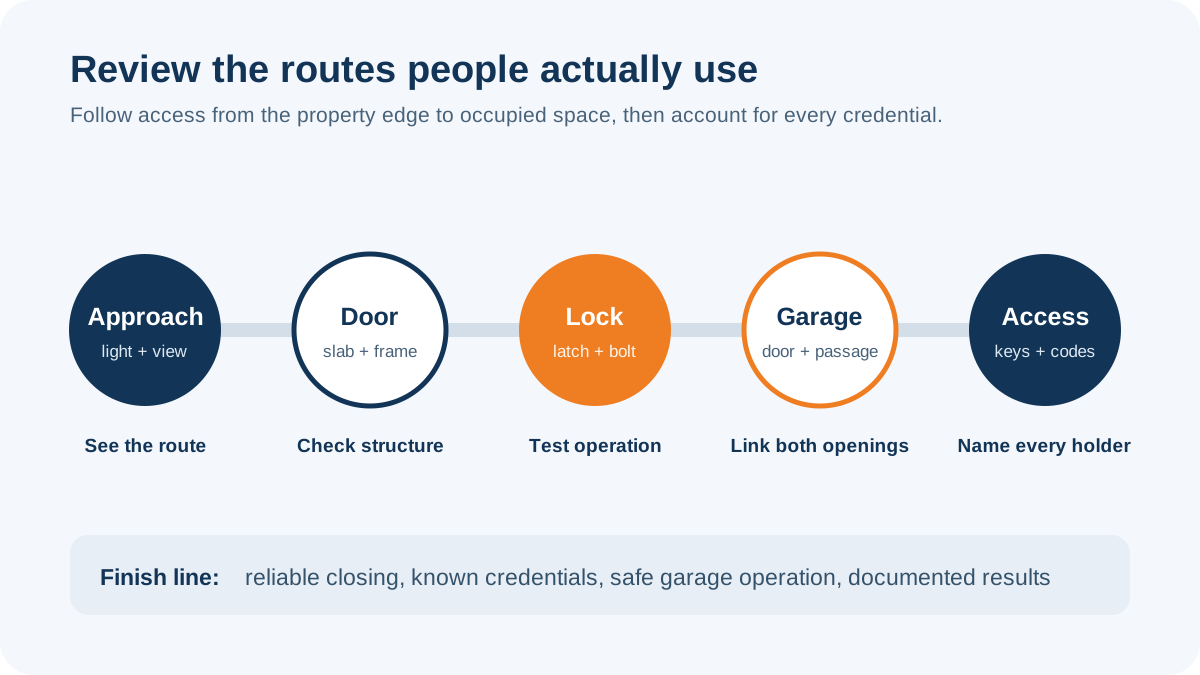
A useful home security review is not a shopping list of gadgets. It is a walk through the routes people actually use: the front and back doors, the door from an attached garage into the house, the overhead garage door, side gates, secondary openings, and every physical or digital credential that controls them. This checklist helps Wichita homeowners record what works, spot what needs professional attention, and prioritize changes without treating every imperfect detail as an emergency.
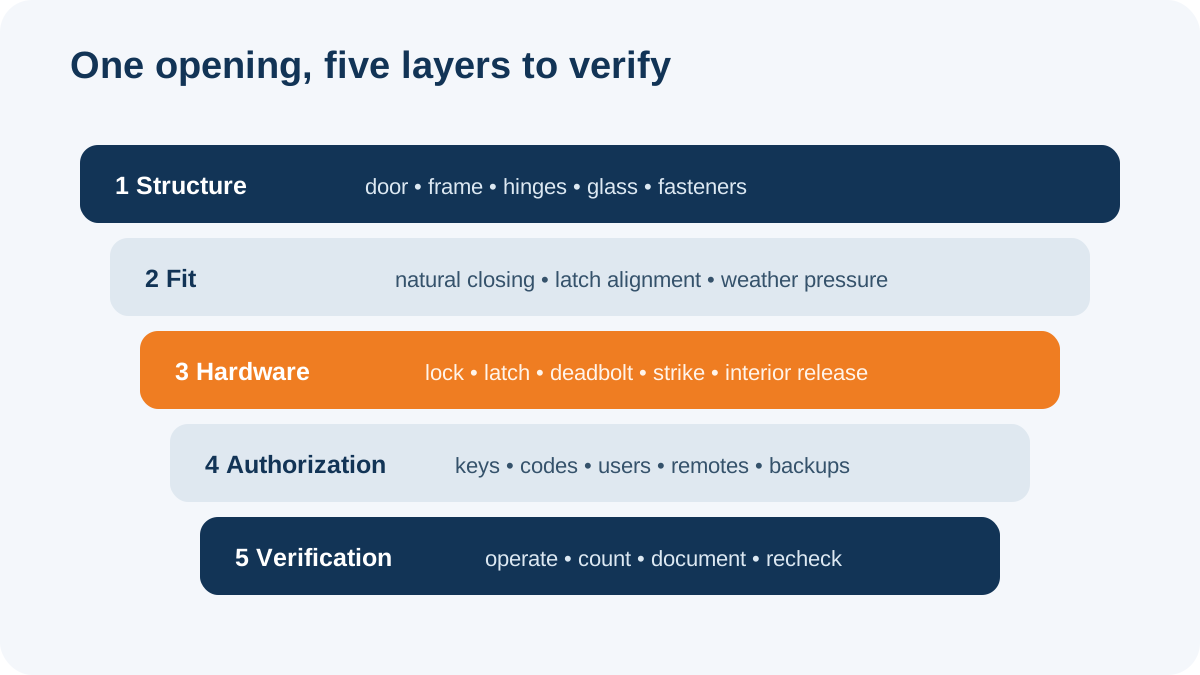
Start at the property boundary and follow each normal route into the living space. At every exterior door, check the slab, frame, hinges, latch, deadbolt, strike, key operation, and interior release as one system. Inventory keys, codes, app users, remotes, and vehicle controls; remove credentials that no longer belong. At the garage, keep the overhead door closed and stationary during visual checks, confirm controls are accounted for, test protective functions only as the manufacturer directs, and stop using a door that is crooked, unusually heavy, binding, or has loose cables or damaged hardware. Rank immediate life-safety and unsecured-entry problems first, then reliability and convenience improvements, and verify every completed repair with a documented handoff.
A useful home security review is not a shopping list of gadgets. It is a walk through the routes people actually use: the front and back doors, the door from an attached garage into the house, the overhead garage door, side gates, secondary openings, and every physical or digital credential that controls them. This checklist helps Wichita homeowners record what works, spot what needs professional attention, and prioritize changes without treating every imperfect detail as an emergency. Continue with the complete library of residential locksmith guides when you want to compare related decisions.
Key takeaways
- Review complete entry routes, not isolated products: door, frame, lock, credentials, garage system, and daily habits work together.
- A lock that binds only when the door is closed may point to alignment or frame conditions rather than the cylinder alone.
- The attached-garage passage door deserves the same deliberate lock and credential review as the front door.
- Garage-door safety devices should be tested only according to the exact opener manual and never bypassed.
- Prioritize exposed openings and unsafe operation, then document keys, codes, remotes, models, tests, and remaining work.
Build the checklist around real entry routes
Begin with a simple plan of the home and mark every route from outside to occupied space. Include the front door, back or patio door, side entrance, basement or walkout door, door from an attached garage, overhead garage door, detached structures, and any gate that controls access to a private area.
Add windows only where they affect a door or access route, such as glazing beside a thumbturn or a basement egress opening. The goal is an inventory you can finish, not a vague promise to inspect everything someday. If this condition matches your situation, review the service scope for wichita locksmith services.
Walk the property in daylight and use the same route a resident, guest, delivery person, or service technician would use. Note whether the address is visible, whether shrubs or stored items block the view of an entry, whether a porch or garage side door is dark, and whether a person can reach a less-used door without being seen from the house. These observations help you decide where maintenance, lighting, visibility, or a change in daily routine may matter more than another device.
Give every opening a stable name such as Front, Rear Patio, Garage-to-House, Overhead Door, or Detached-Shop East. Photograph the inside and outside without capturing key codes, serial numbers, or sensitive documents.
Record the hardware type, how it is normally used, who should have access, and the exact symptom if something is wrong. A named inventory prevents the common mistake of discussing three different 'back doors' in one service request.
Name every route
Use consistent opening names so observations, estimates, repairs, and tests refer to the same place.
Follow normal use
Check how residents actually enter, lock up, carry groceries, and move between the garage and home.
Protect useful details
Document hardware and symptoms without storing codes, key cuts, or sensitive identifiers in casual photos.
Check the door, frame, hinges, and strike before judging the lock
A dependable lock relies on a door that closes naturally into a stable frame. With the opening in sound condition, swing the door slowly and watch for sagging, rubbing, loose hinge movement, a torn seal, daylight at the edge, cracked jamb material, or a latch that misses the strike.
Test the latch and deadbolt with the door open, then closed. If the hardware moves freely open but binds closed, alignment, hinge support, weather pressure, or strike position may be part of the problem. If this condition matches your situation, review the service scope for garage door services.
Do not make force part of the household routine. A door that must be lifted, shoved, kicked, or pulled hard while turning the key is not operating normally, and repeated force can damage keys, cylinders, trim, fasteners, and the frame.
Similarly, a deadbolt should not depend on a partially latched door or a person leaning against the slab. Record whether temperature, wind, or recent construction changes the symptom, because Wichita weather and building movement can make an intermittent fit problem easier to diagnose.
Look at the complete closing sequence rather than only the visible strike plate. The latch should engage, the door should remain closed, the deadbolt should extend and retract smoothly, and interior release should remain straightforward.
Cracks, stripped fasteners, loose glass, water damage, or structural movement can exceed ordinary lock adjustment. A locksmith can address lock and many opening-hardware issues, while significant door, frame, glass, or structural repair may need the appropriate trade as part of a coordinated scope.
- Compare open-door and closed-door lock operation.
- Check hinge movement, rub marks, latch engagement, strike contact, and frame condition.
- Stop treating pushing, lifting, or key force as normal operation.
- Keep interior release usable and confirm the door closes without special handling.
- Route structural, glass, or major door work to the appropriate qualified provider.
Evaluate each lock by condition, function, and fit
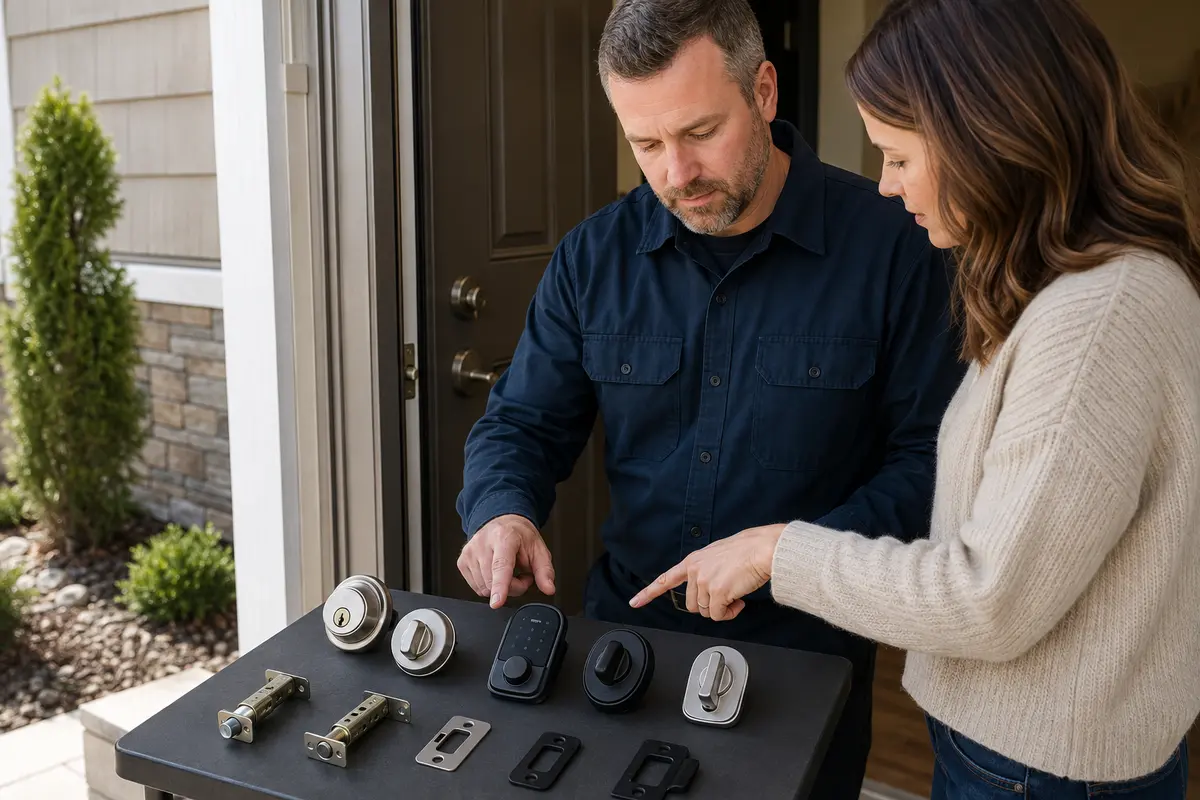
Inspect the hardware gently. Note loose trim, a lever that droops, a latch that retracts only partway, a thumbturn that feels rough, corrosion, cracked components, excessive play, or a key that must be wiggled or partly withdrawn.
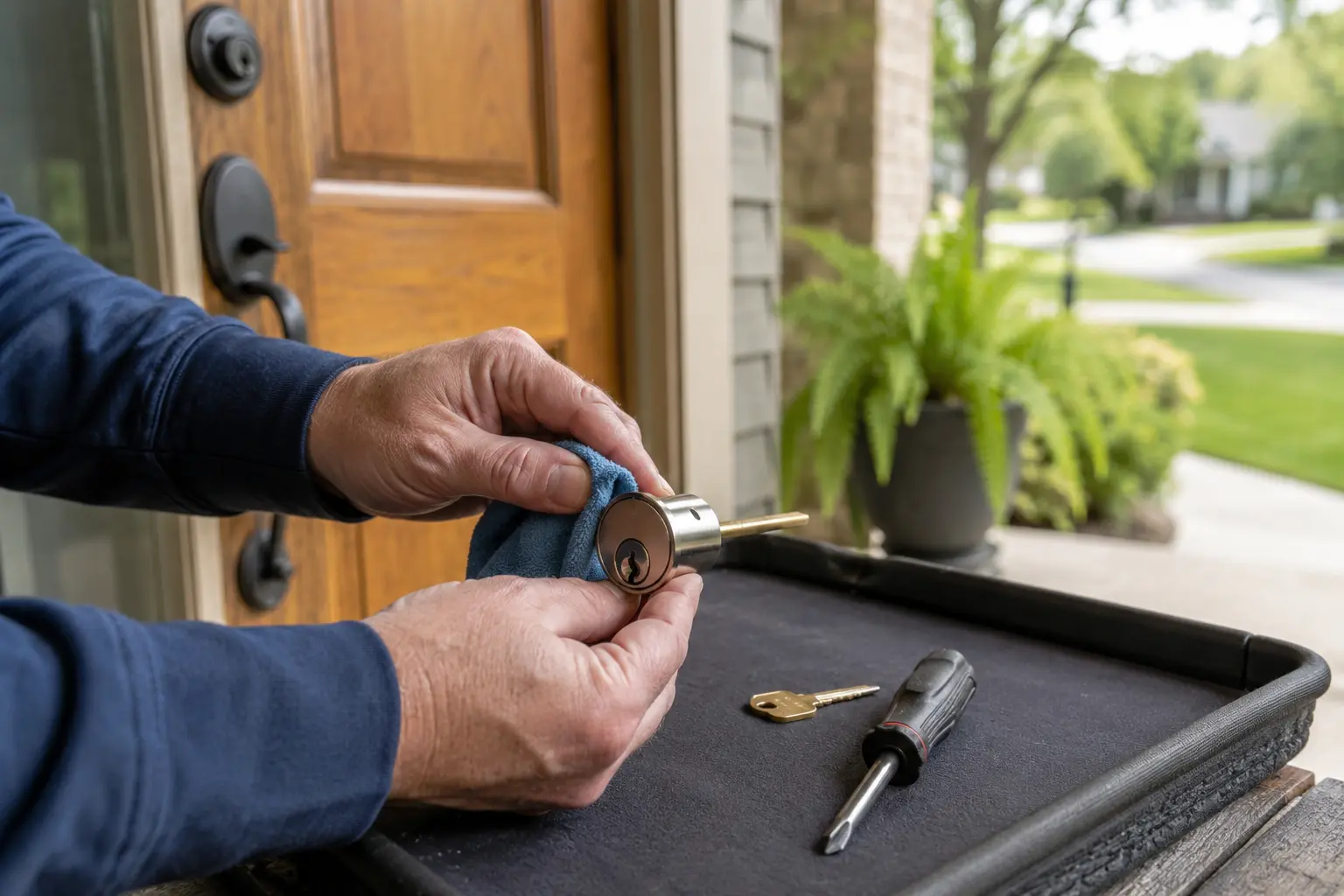
Try a known sound key when available, because a worn or bent copy can imitate a cylinder problem. Never force a key that is twisting, cracked, or difficult to remove; a broken key can turn a manageable symptom into an urgent access problem. If this condition matches your situation, review the service scope for residential locksmith.
Ask what the opening needs to do. A main entrance may need reliable keyed access for household members, while a garage passage door may need a different routine, and an interior closet may not need the same hardware at all.
Confirm that each exterior door has an appropriate locking function, that residents can operate it without confusion, and that the hardware matches the door preparation. Appearance alone does not prove two locks can share a key or accept the same replacement parts.
BHMA's residential lockset standard overview explains that certified residential locksets are evaluated for security, durability, and finish under defined tests. That information can improve a product comparison, but it does not replace an installed-opening review.
Door construction, frame support, strike attachment, preparation, alignment, maintenance, and actual use all influence performance. Compare complete hardware and installation scopes instead of choosing a box by finish or a single marketing claim.
| Observation | What it may indicate | Next step |
|---|---|---|
| Key turns smoothly open and closed | Cylinder and fit appear serviceable | Confirm credential control and keep monitoring |
| Works open but binds closed | Door, hinge, seal, or strike alignment issue | Diagnose the opening before replacing parts |
| Loose trim or partial latch return | Mounting, wear, or mechanism fault | Arrange repair assessment |
| Cracked, corroded, or repeatedly failing parts | Hardware may be unsuitable to retain | Compare compatible replacement scope |
| Unknown key history with sound hardware | Authorization issue rather than proven failure | Consider rekeying after compatibility review |
Create one inventory for keys, codes, apps, and remotes
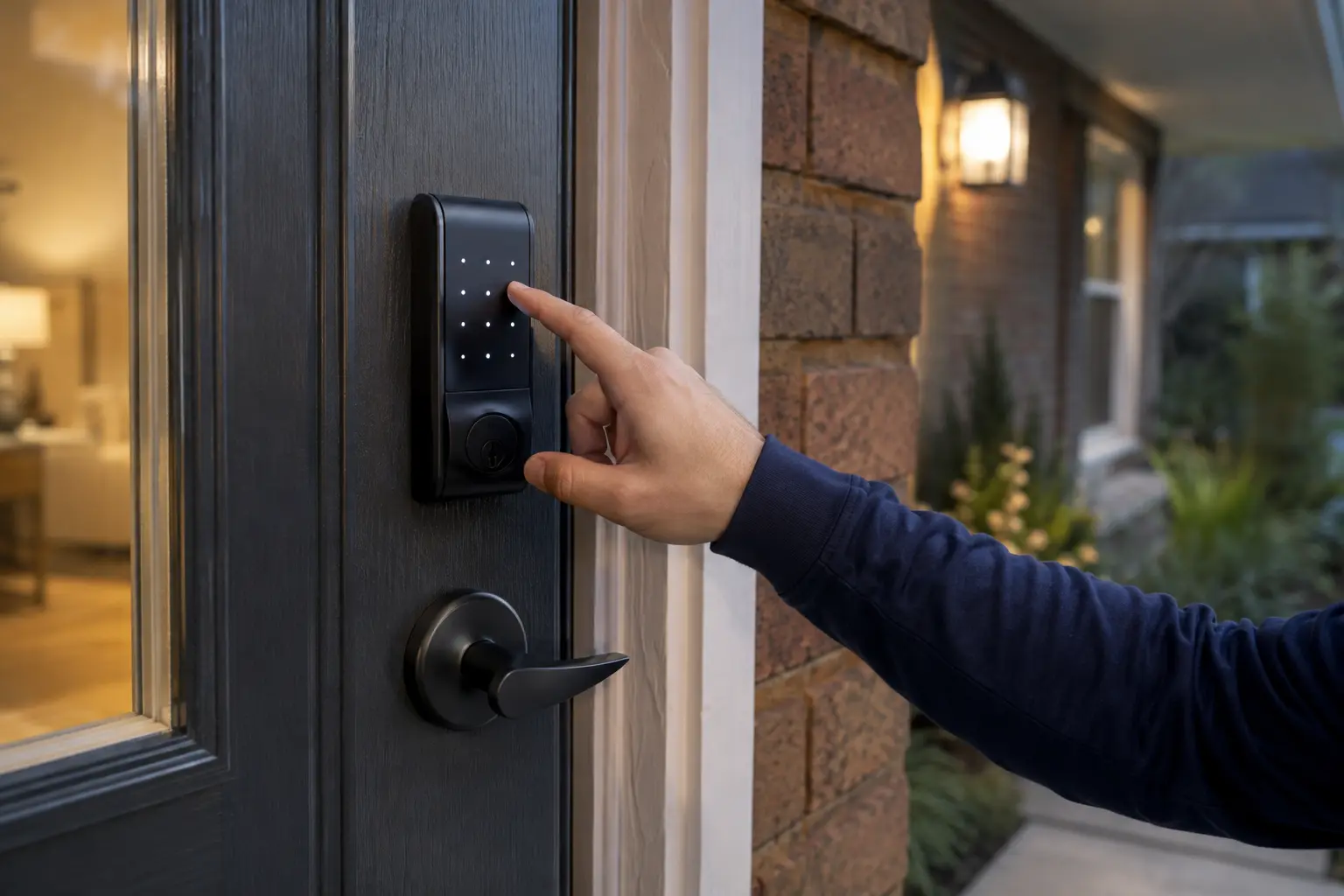
Physical and digital credentials often grow separately until no one can explain the full access picture. List every current house key, garage remote, wireless keypad code, smart-lock user, phone account, vehicle-integrated control, emergency backup key, and trusted-person copy. Record the assigned holder and affected opening, but store the inventory securely and do not write the property address on loose keys or remote labels.
Remove access when a person, service relationship, tenant, employee, or device no longer belongs. For mechanical keys, that may mean recovering copies or rekeying compatible cylinders when the history cannot be trusted.
For smart locks and connected openers, it can mean transferring the owner account, removing former administrators, deleting users, changing shared codes, reviewing integrations, and testing recovery access. A new physical key does not remove a digital user, and a factory reset does not repair a worn deadbolt or unbalanced garage door.
Reduce unnecessary sharing without making everyday access brittle. Individual codes or named users are easier to revoke than one household code shared with everyone, when the product supports them.
Keep a deliberate backup for power, battery, phone, or internet problems, and make sure the people who need it can use it. After changes, test only the new authorized credentials and verify obsolete access is gone without creating a household lockout.
Treat the attached garage as a complete entry sequence
An attached garage creates at least two related openings: the overhead door from outside and the passage door from the garage into the home. Review both.
The overhead system manages a large moving door, while the passage door controls entry to living space after someone is already inside the garage. A dependable opener does not excuse a weak or unreliable passage-door lock, and a good deadbolt does not make a damaged garage-door system safe to operate.
At the garage-to-house door, use the same checklist as any important exterior entry: slab, frame, hinges, latch, lock, strike, key or code, closer behavior if present, and simple interior release. Do not prop it open as a default convenience. If fire-resistance or self-closing requirements may apply to the building, avoid unplanned alterations and have the exact construction and local requirements reviewed by the appropriate qualified professional.
Account for every garage credential, including handheld remotes stored in vehicles parked outside, wireless keypads, phone users, vacation or delivery access, and built-in vehicle controls. When a remote, vehicle, or phone is lost, stolen, sold, or transferred, follow the exact opener and vehicle instructions to remove or reprogram access. Do not assume taking the remote away is enough if its identifier remains enrolled in the opener.
Overhead door system
Review door condition, track area, opener behavior, protective devices, controls, and closing routine.
Garage passage door
Inspect the complete door and lock as a critical route from garage space into the home.
Remote credentials
Count handheld, keypad, mobile, and vehicle controls and remove anything no longer authorized.
Perform only safe garage-door observations
Keep the garage door fully closed and stationary for an ordinary visual review. From a safe distance, look for a door that appears crooked, damaged sections, track movement, loose or hanging cables, frayed components, bent hinges, missing fasteners, unusual gaps, or an opener rail or support that looks displaced.
Do not touch springs, cables, drums, bottom brackets, or other loaded components. If the door is uneven, unusually heavy, binding, or visibly damaged, stop repeated operation and arrange a professional assessment.
Confirm the wall control is visible from the door and not casually reachable by small children, keep remotes away from children, and keep the floor and travel path clear. Do not walk, drive, or allow play beneath a moving door. Never bypass photo eyes, hold a control in an improvised way, increase force to overpower a binding door, or treat a protective reversal as an inconvenience to defeat.
CPSC's garage-door opener safety guidance describes entrapment-protection requirements for automatic residential openers and advises testing according to manufacturer recommendations. Use the exact manual for the opener model, because indicator behavior, test procedures, reset steps, and limits vary. If a required protective function does not work as described, stop automatic use until the problem is properly diagnosed and corrected; do not reposition or bypass devices merely to make the door close.
| Condition | Safe homeowner response | Avoid |
|---|---|---|
| Clear, stationary door with no visible damage | Follow the model manual for routine tests | Inventing a generic test procedure |
| Blocked or dirty photo-eye area | Clear ordinary obstructions without moving brackets | Bypassing or taping sensors |
| Crooked, heavy, binding, or damaged door | Stop repeated use and request service | Adding force or pulling loaded hardware |
| Loose cable, spring, drum, or bottom-bracket concern | Keep clear and call a technician | Touching, loosening, or DIY adjustment |
| Unknown remote or lost vehicle control | Use model instructions to remove credentials | Assuming possession alone controls enrollment |
Review visibility, lighting, and everyday routines
Security improves when ordinary use is easy to observe and easy to complete. Make sure the street number is visible to responders and service providers, exterior fixtures illuminate the approach rather than shining into residents' eyes, and landscaping does not conceal a person working at a door. Repair loose gates, cluttered steps, and trip hazards that make residents rush through locking or leave an entrance open longer than intended.
Build a short closing routine the household will actually follow. Close and latch exterior doors, confirm the overhead garage door reaches its normal closed position, bring remotes and keys under control, remove packages from view, and check only the few secondary openings that are realistically used. A routine should not depend on one person remembering dozens of steps, and it should preserve fast, uncomplicated exit from inside during an emergency.
Avoid announcing extended absence through obvious signs, unsecured deliveries, or unnecessary public detail. Use trusted people and appropriate account features deliberately, then remove temporary access when it ends. Cameras and alerts can provide useful information, but they do not replace a door that closes, a lock that operates correctly, known credentials, or a response plan for an alert that arrives when no one is home.
- Keep the address and main approach visible.
- Aim lighting at walking and working areas without creating disabling glare.
- Trim concealment near doors while preserving intentional privacy.
- Choose a short nightly routine that includes the overhead garage door.
- Preserve clear, simple emergency exit from inside the home.
Prioritize findings by exposure and consequence
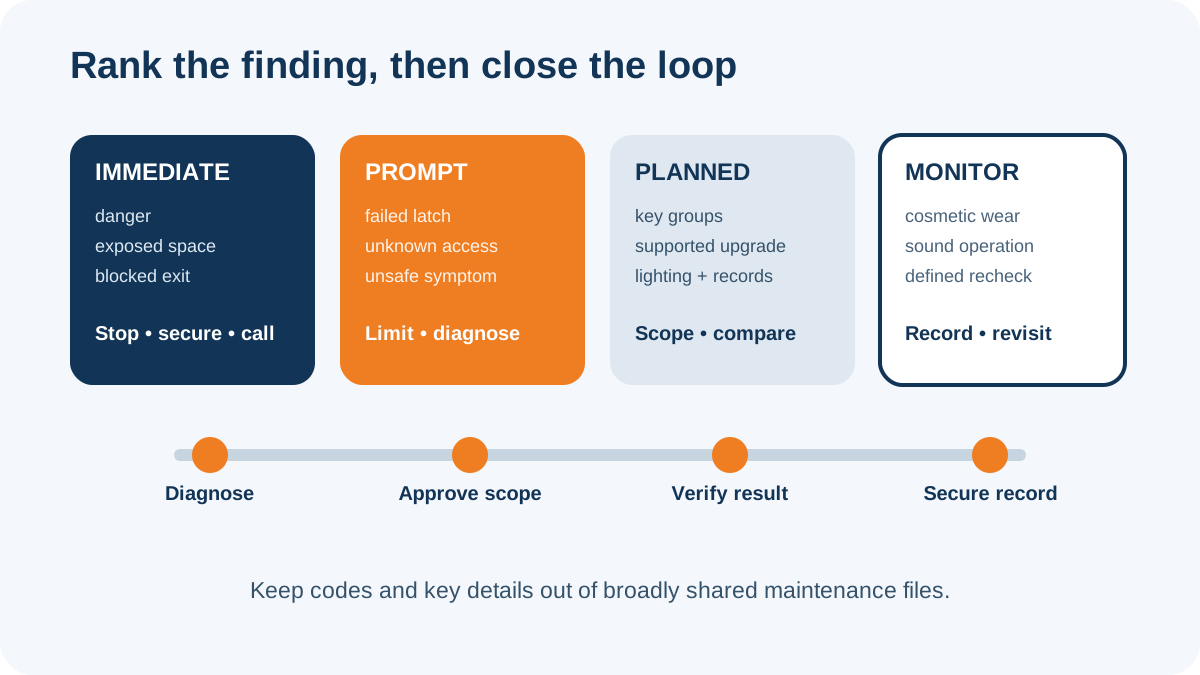
Not every checklist item carries the same urgency. First address immediate danger, failed required protective behavior, an opening that cannot provide necessary exit, a door that is visibly unstable, exposed living space, or credible evidence that an unauthorized person retains access. If there is an active threat, fire, medical emergency, suspected intruder, or other immediate danger, move to safety and contact 911 rather than beginning repair work.
Next address unreliable operation and access-control gaps: a door that does not latch, a key that is near breaking, unknown move-in keys, an active former user, a lost garage remote, recurring opener faults, or a passage door that is regularly left unsecured. Then plan resilience and convenience improvements such as consolidating compatible key groups, adding managed individual codes, improving lighting, documenting model information, or scheduling preventive maintenance.
Use a written scope for anything beyond a simple adjustment. Identify the exact openings, observed conditions, proposed repair or replacement, included hardware, credential changes, testing, cleanup, taxes, exclusions, timing, and warranty. For a project that crosses locksmith and garage-door work, keep the two technical scopes distinct while preserving the connection between the overhead entry and the door into the house.
| Priority | Examples | Action |
|---|---|---|
| Immediate | Active danger, unsafe moving door, exposed living space, blocked necessary exit | Move to safety, stop use, and contact the right emergency or service provider |
| Prompt | Unreliable latch, binding lock, unknown credentials, lost remote, failed protective test | Limit use as appropriate and schedule diagnosis |
| Planned | Key-group cleanup, supported upgrades, lighting, records, preventive service | Compare complete options and budget deliberately |
| Monitor | Cosmetic wear with sound operation | Record condition and recheck at a defined interval |
Verify repairs and keep a useful home security record
Closeout should prove the result at every serviced opening. Let a door close naturally, confirm the latch engages, operate the authorized key or credential, verify the bolt extends without lifting or pushing, and confirm easy interior release. For the garage, follow the manufacturer-directed commissioning and protective tests, count controls, and verify normal travel without standing or passing beneath the moving door.
Record the service date, opening name, diagnosis, work performed, product or model, key group, credentials issued or removed, test results, invoice, and written warranty. Keep this record securely away from the keys and do not include reusable access codes in a broadly shared home-maintenance file. Update it after a move, lost credential, household change, major door repair, new vehicle, opener replacement, or smart-account transfer.
Heartland's Wichita locksmith services are the starting point for door locks, rekeying, keys, and access questions, while its garage door services cover the overhead door, opener, controls, and garage-system diagnosis. The residential locksmith page provides a direct path for household lock work. A good checklist does not end with a longer shopping list; it ends with reliable openings, known credentials, safe garage operation, clear priorities, and a record the household can use next time something changes.
Test the complete cycle
Close, latch, lock, unlock, release, and operate each serviced system as intended.
Transfer every credential
Account for keys, codes, users, remotes, vehicle controls, and deliberate backups.
Preserve the baseline
Keep diagnoses, models, key groups, tests, invoices, and warranty terms in a secure record.
Frequently asked questions
Questions readers ask
What should I check first in a home security review?
Start with each route into occupied space. Confirm the door and frame are stable, the latch and lock work without force, interior exit is simple, and every key, code, app user, or remote is known. Address immediate hazards and exposed openings before convenience upgrades.
Should the door from an attached garage be checked like an exterior door?
Yes. It controls access from the garage into the living space and should be reviewed as a complete opening: door, frame, hinges, latch, lock, strike, credentials, closing behavior, and interior release. Avoid unplanned changes when fire-resistance requirements may apply.
Does a binding deadbolt always mean the lock must be replaced?
No. If the deadbolt works with the door open but binds when closed, hinge movement, weather-seal pressure, strike alignment, or frame condition may be involved. Diagnose the complete opening before choosing repair or replacement.
How should I test garage-door safety sensors?
Use the exact procedure in the opener manufacturer's current manual for that model. Keep the area clear, never bypass protective devices, and stop automatic use if a required protective function does not work as described.
What garage-door conditions mean I should stop using it?
Stop repeated operation when the door is crooked, unusually heavy, binding, visibly damaged, or associated with loose cables, displaced tracks, damaged springs, drums, bottom brackets, or supports. Keep clear of loaded parts and arrange professional diagnosis.
How often should I update the checklist?
Review it after moving, losing a key or remote, changing household access, transferring a vehicle or smart account, repairing a door, replacing an opener, or noticing a new symptom. A brief scheduled review can also help catch slow wear and stale credentials.
The right solution depends on the specific lock, door, vehicle or garage door system. Check the Wichita-area service pages, then call or send the details for an evaluation.